Map by Nobunaga (Original) and gimil / lanyards (Revamp)
Guide by alstergren
- Click image to enlarge.
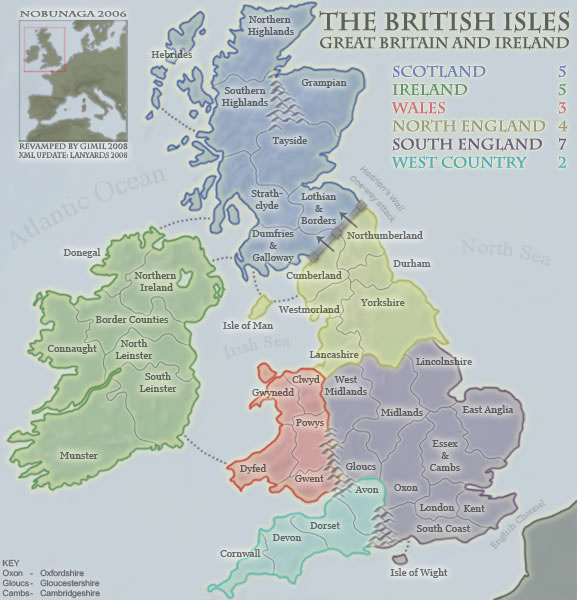
The British Isles map is, as it names implies, a map covering the UK, Ireland and some other smaller islands that are part of the archipelago. The map has 42 regions with 6 bonus zones. This provides a good sized map for 2-6 player games.
The British Isles map is a simple, conservative and classic-style Conquer Club map. It was originally released in April 2006 during the website’s dawn and revamped in January 2009. The seas surrounding the islands, mountain ranges (impassable) and two “one way borders” (separating the North England and Scotland bonus zones) break up the map into the separate bonus zones. The map relies primarily on region count advantage and zone bonuses to provide an edge in each game. Consequently, being a simple, old school map - what works on Classic generally works on the British Isles map.
Classification
Size: Medium (42 regions)
Bonuses: Balanced
Complexity: Easy
Features
Bonuses: Balanced
Complexity: Easy
Features
- One Way Borders - Cumberland assaults and reinforces into Dumfries & Galloway and Northumberland assaults and reinforces into Lothian & Borders (but not vice versa).
Two Player
In a 2 player game, each player starts with 14 regions (i.e. leaving 14 neutral regions). Irrespective of the spoils type, an early possession of the West Country bonus zone (+2 troop bonus) or an early region count advantage (one player holding 17 or more regions with the other player holding 11 or less regions) may be decisive for the outcome of the game. Preventing the opponent from getting a region count advantage and/or holding West Country should be an overarching priority.
Naturally, in a flat rate or escalating spoils game, the importance of the possession of West Country and/or a region count advantage wears off after a few rounds. However, in a no spoils game, any one of these advantages tends to be the decisive factor in the vast majority of 2 player games.
Under the right circumstances (taking into account the initial 14 neutral regions), it may be possible to conquer and attempt to hold Wales (with three entry points). Attempting this is usually a gamble but, if successful, the +3 troop bonus generally ensures victory. The remaining bonus zones (Ireland, North England, Scotland and South England) are rarely worth an effort in a 2 player game due to their size and likely number of neutral regions.
Spoils
With the British Isle map being a rather simple, straight forward old school map - what works on Classic generally works on this map.
There is nothing particularly special to this map concerning no spoils, flat rate and nuclear games. Here, the map-specific points under the “Two Player” and “Team Games” sub-sections may be helpful in addition to the general strategy guides on these topics.
With respect to escalating games, the only bonus zone one should attempt to hold in these games is West Country.
As usual, it may be sensible to spread out across the map in order to increase one’s reach (i.e. to have a launching pad for assaults in different areas of the map) once the spoils sets increase in value. Several bottleneck regions exists:
A number of dead end regions exist:
The British Isle map’s many bottleneck regions and dead end regions allows for challenging escalating games as it takes careful planning and timing to eliminate one’s opponents.
There is nothing particularly special to this map concerning no spoils, flat rate and nuclear games. Here, the map-specific points under the “Two Player” and “Team Games” sub-sections may be helpful in addition to the general strategy guides on these topics.
With respect to escalating games, the only bonus zone one should attempt to hold in these games is West Country.
As usual, it may be sensible to spread out across the map in order to increase one’s reach (i.e. to have a launching pad for assaults in different areas of the map) once the spoils sets increase in value. Several bottleneck regions exists:
- Dyfed / South Leinster is the only assault route between Ireland and Wales.
- Avon separates South England and West Countries.
- Dumfries & Galloway / Isle of Man is the only assault route from Scotland into North England (but not vice-versa due to the one way borders).
A number of dead end regions exist:
- Cornwall (blocked by Devon).
- Grampian (blocked by Tayside).
- Hebrides (blocked by Southern Highlands).
- Isle of Wight (blocked by South Coast).
- Munster (blocked by South Leinster).
- Northern Highlands (blocked by Southern Highlands)
The British Isle map’s many bottleneck regions and dead end regions allows for challenging escalating games as it takes careful planning and timing to eliminate one’s opponents.
Team Games
With respect to the basic set-up: In 4 player doubles games, each player starts with 10 regions, in triples games, each player starts with 7 regions and in quadruples games, each player starts with 5 regions.
Considering the map size (42 regions), the best strategy in quadruples games is usually to target and attempt to eliminate one of the players in the opposing team (once done, one simply continues targeting the remaining opponents one by one).
With respect to doubles or triples games, and irrespective of the spoils type, an early possession of the West Country bonus zone may be an important edge. It may also (at least in doubles games) be possible to seize and hold any of the Ireland, North England or Wales bonus zones (each with three entry points).
Preferably, when defending any of these bonus zones, one should try to put up troop blocks in an adjacent region outside the bonus zone itself. For example:
Without a good initial troop drop, it is difficult to seize and hold more than one bonus zone. However, this should be sufficient if one at the same time is able to ensure that the opposing team is unable to hold a different bonus zone. Having secured a bonus zone, a team has two basic strategies to choose from. The first choice would be to target one of the players in the opposing team (and once eliminated, continue targeting the remaining opponents one by one). The second choice would be to push the advantage by expanding out from the held bonus zone slowly grinding down the opposing team.
Considering the map size (42 regions), the best strategy in quadruples games is usually to target and attempt to eliminate one of the players in the opposing team (once done, one simply continues targeting the remaining opponents one by one).
With respect to doubles or triples games, and irrespective of the spoils type, an early possession of the West Country bonus zone may be an important edge. It may also (at least in doubles games) be possible to seize and hold any of the Ireland, North England or Wales bonus zones (each with three entry points).
Preferably, when defending any of these bonus zones, one should try to put up troop blocks in an adjacent region outside the bonus zone itself. For example:
- Ireland can be defended with troop blocks on Dumfries & Galloway / Strathclyde (Scotland) and Dyfed (Wales).
- North England can be defended with a troop block on Dumfries & Galloway (Scotland) in addition to Lancashire / Yorkshire.
- Wales can be defended with troop blocks on Lancashire (North England), South Leinster (Ireland) and West Midlands (South England).
Without a good initial troop drop, it is difficult to seize and hold more than one bonus zone. However, this should be sufficient if one at the same time is able to ensure that the opposing team is unable to hold a different bonus zone. Having secured a bonus zone, a team has two basic strategies to choose from. The first choice would be to target one of the players in the opposing team (and once eliminated, continue targeting the remaining opponents one by one). The second choice would be to push the advantage by expanding out from the held bonus zone slowly grinding down the opposing team.
Additional Notes
There is nothing particularly special to this map concerning assassin and terminator games or games with a fog of war or manual deployment setting, the general strategy guides on these topics may be helpful.
The following region abbreviations are used in the map graphics:
Looking at the ratio between bonus troops and the number of defense points, one can conclude that the British Isle map is reasonably balanced bonus wise. The two exceptions are the West Country bonus zone with the high 2 bonus troops/defense point ratio and the Wales bonus zone with the low 1 bonus troops/defense point ratio. Even if it may be tempting to attempt to secure and hold Wales, it is rarely worth the effort as it is relatively easily reached by one’s opponents due to its central location and the relatively low reward per round if holding it. Rather than Wales, one may be better off in the long-run attempting to secure and hold Ireland with its less accessible location and higher reward per round if holding it.
The following region abbreviations are used in the map graphics:
- Oxon - Oxfordshire
- Gloucs - Gloucestershire
- Cambs - Cambridgeshire
- Cumberland assaults and reinforces into Dumfries & Galloway, but troops on Dumfries & Galloway cannot assault or reinforce into Cumberland (a one-way border).
- Northumberland assaults and reinforces into Lothian & Borders, but troops on Northumberland cannot assault or reinforce into Lothian & Borders (a one-way border).
- Sea routes allow assaults and reinforcements between the bonus zones Ireland / Wals, Ireland / Scotland and North England / Scotland as well as the regions Isle of Wight / South Coast and Hebrides / Southern Highlands.
- West Country: +2 troop bonus, one entry point (i.e. 2 additional troops per tied down defense point).
- South England: +7 troop bonus, four or five entry points (i.e. 1.75 or 1.4 additional troops per tied down defense point).
- Ireland: +5 troop bonus, three entry points (i.e. 1.66 additional troops per tied down defense point).
- Wales: +5 troop bonus, three entry points (i.e. 1.66 additional troops per tied down defense point).
- North England: +4 troop bonus, three entry points (i.e. 1.33 additional troops per tied down defense point).
- Scotland: +5 troop bonus, four entry points (i.e. 1.25 additional troops per tied down defense point).
Looking at the ratio between bonus troops and the number of defense points, one can conclude that the British Isle map is reasonably balanced bonus wise. The two exceptions are the West Country bonus zone with the high 2 bonus troops/defense point ratio and the Wales bonus zone with the low 1 bonus troops/defense point ratio. Even if it may be tempting to attempt to secure and hold Wales, it is rarely worth the effort as it is relatively easily reached by one’s opponents due to its central location and the relatively low reward per round if holding it. Rather than Wales, one may be better off in the long-run attempting to secure and hold Ireland with its less accessible location and higher reward per round if holding it.