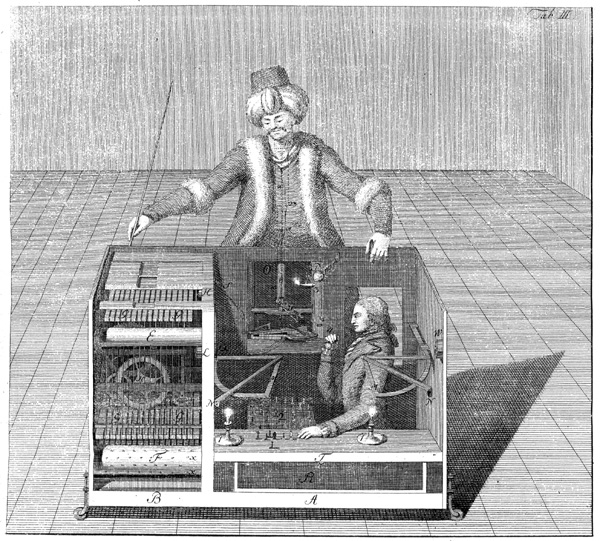
nippersean wrote:Well my thoughts - if a computer can beat Kasparov, then they have an outside chance of beating GLG.
Seriously, with enough resources a program would beat (be better) than everyone at this game. Without a doubt.
It is far more difficult to assess a chess position at the end of the algorithm than to calculate a 6 player KO. Always when the machine comes to the end of brute force it will have to assess who is better. This is way more difficicult in chess than it is in CC.
Difference is IBM unlikely to spend $1Bn+ on a CC program. I think it's rather silly to say CC / risk is more complex than chess.
It is not accurate to state that strongest computer defeats strongest human in chess at this point of history. In all the 3 last matchs played (the one Kasparov won 3.5-2.5, the one Kasparov lost 3.5-2.5 and the last one Kramnik lost 3.5-2.5), the human player managed to win at least one game. And the last match was 2.5-2.5, about to end in a tie with the last game being a completely drawn position when Kramnik made a remarkable mistake for his level (blundering checkmate in one move) which is made once or twice in a lifetime for such a strong player. Anyway, the point is that computers have a stable level of performance in all games, calculating millions of moves. Humans do not. A single mistake will lead to defeat against machines. But if on their best performance, strongest human chess players can still defeat computers, which means both not making mistakes AND playing superior strategy, this means computers have not bypassed humans yet. At least for a few more years, lol
The strongest human chess players are rated around 2800 elo. The top chess playing programs are now over 3200. The world chess champion would not stand a chane now. Chess Grandmasters no longer play against chess computers in matches because there is no point in it. They use computers to help prepare for matches against other humans.
Probably, but that was not my point. My point is that although computers have a superior average performance, humans can still prevail in a game they show their top performance. Which in turn means that computers still make critical mistakes, at least in some kind of positions. Computers do not blunder, they have a stable performance at the rating you say, but humans' performance vary greatly, mainly because of the chance to find or miss critical tactics. And apparently they can still defeat computers in isolated games, although not in a match probably, when they perform their best. The next stage of computer evolution is the day we will have to accept that humans have 0% chance to defeat a computer in a single game and that computers do not make mistakes. At least not significant ones that could lead to a loss.
Computer preparation is part of every chesplayer agenda for 20 years. Doesnt mean much by itself. Examples like the Kramnik-Leko match on 2000 (I think), where one player prepares a position computer tells him he is winning and the opponent finds out, unprepared, over the board, thinking hard, that in fact the position is lost are still not uncommon. Opening novelties computers disapprove are still common. And the remarkable inability of computers to recognize drawing fortresses still leads to huge misevaluations.
In contrast, the american verion of checkers has been strongly refuted. This means that top computers can never lose a game, only win or draw. Computers will never theoriticaly succeed in that (get data info in all positions that can arise through optimal play) and still need some years to practicaly succeed in that
Kaskavel wrote:In contrast, the american verion of checkers has been strongly refuted. This means that top computers can never lose a game, only win or draw. Computers will never theoriticaly succeed in that (get data info in all positions that can arise through optimal play) and still need some years to practicaly succeed in that
I would say that for all practical purposes chess has been "solved" in the sense that I don't believe even the World Chess Champion would win one game out of a hundred against them today. Backgammon on the other hand, while computers are world class (GnuBackgammon is in the Top 5 of over 6000 rated Players on FIBS) the luck of the dice makes them beatable but by only the strongest human players. I would put Risk in the same category. While I believe a program could be developed that would conquer the vast majority of players, it would always be possible for a strong human player to compete with them.
Kaskavel wrote:In contrast, the american verion of checkers has been strongly refuted. This means that top computers can never lose a game, only win or draw. Computers will never theoriticaly succeed in that (get data info in all positions that can arise through optimal play) and still need some years to practicaly succeed in that
I would say that for all practical purposes chess has been "solved" in the sense that I don't believe even the World Chess Champion would win one game out of a hundred against them today.
That's a strong claim; I wonder what the numbers are. Nevertheless, the top chess engines are now 500 FIDE points better than the top grandmasters. At that level of play, 500 point upsets are incredibly rare. It is possible for a 2300-level player to beat a 2800-level player, but even though that happens once in a (very long) while no one insists that the 2300 level player is comparable to the 2800 level player. I'm confident that computers are now better than humans for the same reason.
I may be a little off. A 500 point spread would give a human maybe a 4% chance of winning a game.
Do you know of a reference that has this analysis? I'd be curious to see how strongly this is a function of the actual ratings (after all, a 500 point spread between a 1400 and a 900 is not the same as a 500 point spread between a 2800 and a 2300, even if it should be in principle, because ratings are much less likely to be an accurate representation of a player's skill at the lower end).
Yes, but computer's performance is stable, human's is not. A 2800 player occasionaly make performances at 2500 or 3100. The computer never makes a performance at 2900 or 3500.
Another parameter that complicates matters is that humans "cheat". They exploit the computer's small weaknesses. In the last match, Kramnik almost won a game by bringing up a position where he knew that computer would not understand that the best move was exchanging bishop for knight (Bxf3 in a catalan) because the horizon of knight's superiority was too big for a computer. They systematicaly try to bring up closed calm strategic positions and avoid great tactical calculations. The computer's ability to do that by taking orders to do the opposite is more complicated and difficult.
Kaskavel wrote:Yes, but computer's performance is stable, human's is not. A 2800 player occasionaly make performances at 2500 or 3100. The computer never makes a performance at 2900 or 3500.
Another parameter that complicates matters is that humans "cheat". They exploit the computer's small weaknesses. In the last match, Kramnik almost won a game by bringing up a position where he knew that computer would not understand that the best move was exchanging bishop for knight (Bxf3 in a catalan) because the horizon of knight's superiority was too big for a computer. They systematicaly try to bring up closed calm strategic positions and avoid great tactical calculations. The computer's ability to do that by taking orders to do the opposite is more complicated and difficult.
It's actually the computer that cheats with a built in book but they are they are so strong now that it is just about impossible for any human to find those weaknesses at tournament time controls which is 40 moves in 2 hours. The only way possible I would think a human can still compete is through "correspendence chess" where there are no time limits. Even then I have my doubts. Like I said earlier, I believe programming a Risk program would be more similar to Backgammon than Chess with the dice. The computer would never dominate like it does in chess.
Both are cheating in opening preparation, just in a different way. Do not underestimate the abilty of strong players to learn and recall thousand of moves in the opening. I do it, and I am not 2800. And do not underestimate his ability to scan through them through pure instict plus choosing the one that leads to a more "human" position. Computer's basic cheating is in the endgame, containing all positions with 6 or less pieces on board. As far as a position is left with 6 or less pieces, computer make no mistake. Ever. This is more important that opening databases because in opening, human can always understand and judge, in the endgame, computer can play the strongest moves that sometimes make no sence to the human mind.
And yes, of course. Computer will never dominate risk or backgammon. Or any other at least medium-related dice game. Playing the best move in those games does not lead necessary to a win, you can lose, even from an opponent who makes mistakes. Chess is a different category.
Kaskavel wrote:And yes, of course. Computer will never dominate risk or backgammon. Or any other at least medium-related dice game. Playing the best move in those games does not lead necessary to a win, you can lose, even from an opponent who makes mistakes. Chess is a different category.
I disagree; you just need to have a different definition of "dominate." A computer AI may never win 75% of the time, but it will significantly more often than humans, which means it will dominate on average.
Kaskavel wrote:Both are cheating in opening preparation, just in a different way. Do not underestimate the abilty of strong players to learn and recall thousand of moves in the opening. I do it, and I am not 2800. And do not underestimate his ability to scan through them through pure instict plus choosing the one that leads to a more "human" position. Computer's basic cheating is in the endgame, containing all positions with 6 or less pieces on board. As far as a position is left with 6 or less pieces, computer make no mistake. Ever. This is more important that opening databases because in opening, human can always understand and judge, in the endgame, computer can play the strongest moves that sometimes make no sence to the human mind.
Kaskavel wrote:Both are cheating in opening preparation, just in a different way. Do not underestimate the abilty of strong players to learn and recall thousand of moves in the opening. I do it, and I am not 2800. And do not underestimate his ability to scan through them through pure instict plus choosing the one that leads to a more "human" position. Computer's basic cheating is in the endgame, containing all positions with 6 or less pieces on board. As far as a position is left with 6 or less pieces, computer make no mistake. Ever. This is more important that opening databases because in opening, human can always understand and judge, in the endgame, computer can play the strongest moves that sometimes make no sence to the human mind.
I don't really disagree with what you are saying but the knowledge of opening moves is what makes a Grandmaster a Grandmaster. If the computer had to analyze from move one without a human entering a database (opening or ending) a human could probably steer it to a position that would be fatal for the computer much more often. Chess being solved was one of the fears Bobby Fischer had. That is one reason he came up with Fischer Random Chess but even in that variation I don't believe the results would be much different.
To see how big a difference dice can make: A computer will win about 97 out of every 100 games against the World Chess Champion. On the other hand "Snowie" the Backgammon computer king is rated only about 50 elo points above the strongest human players. Huge difference! In the next couple of years Chess programs will be 100% unbeatable by any human.
It's just a matter of resources, they spent more money on chess.
The backgammon resources have been far less. Computer bods took the decision to take on the most difficult game (chess), because to analyse a position is hard for a computer. And they still kicked ass, in the most competitive game in the world.
OK re cof comment, Kasparov was clearly cheated, but if you read his books, he describes "the machine" as "all
seeing" and "bloodthirsty"
And to Kaska re computers inability to think, i wish you were right, but check Kasimdzhavonv v Kasparov Linares 2005 - Kasparov got given the search engine, thought he'd found a hole (playing white) , then realized the computer was right (playing black) and switched sides.
nippersean wrote:It's just a matter of resources, they spent more money on chess.
The backgammon resources have been far less. Computer bods took the decision to take on the most difficult game (chess), because to analyse a position is hard for a computer. And they still kicked ass, in the most competitive game in the world.
OK re cof comment, Kasparov was clearly cheated, but if you read his books, he describes "the machine" as "all
seeing" and "bloodthirsty"
And to Kaska re computers inability to think, i wish you were right, but check Kasimdzhavonv v Kasparov Linares 2005 - Kasparov got given the search engine, thought he'd found a hole (playing white) , then realized the computer was right (playing black) and switched sides.
So you believe Backgammon programs will eventually dominate the way they have in chess?
I believe the dice will not allow the same level of domination. That gives hope to Conquer Club players when someone tries to become the next Conquerer with some computer program.
I believe the dice allow more domination, since they are easily calculated, of course anyone can get lucky once in a while, even rubbish players can throw lots of double sixes.
But who would want to become conk using a program? What would be the point?
For IBM it was a statement and advertisement, I don't believe being conk on CC holds the same weight as beating the best chess player of all time.
Personally, knowing that there are better programs and better chess players / backgammon / CC + poker players doesn't stop me enjoying having a game.
When i lived in England, back in 1994, i had no idea about computers, but i believed i can play chess, and i lost against the computer at the hardest level,
i started to write down my moves, when i realized one mistake the computer made, in the second game i beat him,
then i played the same opening, the same moves until the crucial mistake moment of the computer, i realised that the comp is doing all the same,
finaly i beat the comp, i didnt even bother to play different openings or moves, my goal was just to beat the computer, i succeeded ,
today i dont play chess anymore, i dont have any opponents, not many people play chess in real life, not in my close friendship or community,
anyway, i believe, that a human can beat a comp if he starts to know his weak point,
the old greek achiles nerve, i believe in human intelligence, artificial intelligence is programmed by human intelligence,
to much philosophy now, we have been there before, everything happened, its just repeating itself, humans win
I used to roll the daizz
Feel the fear in my enemy´s eyes
Listen as the crowd would sing: Long live the Army Of Kings !
AslanTheKing wrote:When i lived in England, back in 1994, i had no idea about computers, but i believed i can play chess, and i lost against the computer at the hardest level,
i started to write down my moves, when i realized one mistake the computer made, in the second game i beat him,
then i played the same opening, the same moves until the crucial mistake moment of the computer, i realised that the comp is doing all the same,
finaly i beat the comp, i didnt even bother to play different openings or moves, my goal was just to beat the computer, i succeeded ,
today i dont play chess anymore, i dont have any opponents, not many people play chess in real life, not in my close friendship or community,
anyway, i believe, that a human can beat a comp if he starts to know his weak point,
the old greek achiles nerve, i believe in human intelligence, artificial intelligence is programmed by human intelligence,
to much philosophy now, we have been there before, everything happened, its just repeating itself, humans win
I hope you don't take this the wrong way but do you know the difference between a pawn and the rear end of a Knight? Just trying to interject a little humor. Grandmasters no longer play matches against computers because it is futile.
AsianKing if you want to see how strong even a computer program several years old is simply download a copy of Slow Chess Blitz and it will beat you 100% of the time. It is "weak" compared to Rybka and others.