No, Living in Beijing is NOT Equivalent to Smoking 40 Cigarettes Per Day
Ah, Berkeley, The Economist: These words ooze credibility at their very core. So when a recent article in The Economist cited a study by an organization called Berkeley Earth claiming that breathing in Beijing is the equivalent of smoking 40 cigarettes per day, the surfing masses conditioned by social media to only read headlines immediately shared it on their social media streams. The result went viral.
And it is complete horsesh*t.
In short, for those of you who don’t care to read the mathematical calculations below, nowhere in China is the air pollution anywhere near the equivalent of smoking even one cigarette per day – a fact that Beijing’s own Dr Richard St Cyr pointed out in 2011 in this pioneering blog post.
Nevertheless, the editors of The Economist musn't have seen that. They quoted Berkeley Earth, a non-profit organization founded by environmentally-conscious scientists (with no direct relationship to the university in California), saying “Berkeley Earth’s scientific director, Richard Muller, says breathing Beijing’s air is the equivalent of smoking almost 40 cigarettes a day.” This factoid was alluded to in the bold print of The Economist's accompanying graphic, shown below:
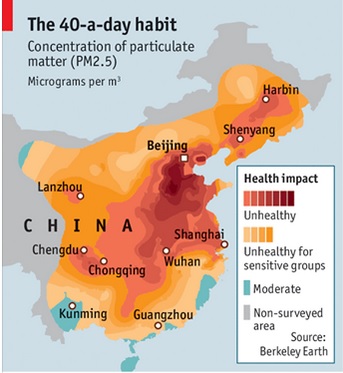
The quote appears to stem from a press release from Berkeley Earth, as their study itself makes no reference to cigarette equivalents of Beijing’s air.
But Berkeley director Muller's original statement was, and I quote: “When I was last in Beijing, pollution was at the hazardous level; every hour of exposure reduced my life expectancy by 20 minutes. It’s as if every man, woman, and child smoked 1.5 cigarettes each hour,” he said. The Economist probably multiplied this by 24 hours per day, came up with 36 and rounded up to a nice 40 for measure.
I have no explanation how Muller made his calculation of 1.5 cigarettes an hour (though I'll attempt to reverse-engineer it below).
One explanation could be that he fell prey to the age-old measurements mixup, confusing milligrams (one thousandth of a gram, often used when reporting tar and nicotine and other pollutants in cigarettes) and micrograms (one millionth of a gram, used in most air quality measures such as PM 2.5 and PM 10). A milligram is 1,000 times larger than a microgram.
Now onto the fine print of our calculations: If it's not 40 a day, exactly how many cigarettes are we Beijingers each day simply by breathing?
First of all, let’s not parse words here, there are a million ways to dispute the equivalency of cigarette smoke and air pollution – they’re apples and oranges. I'm not here to argue over the various evil components of air pollution vs cigarette smoke (they're both bad). For our purposes I am attempting to address the 40-cigarettes-per-day equivalency claim, which appears to be based on the PM 2.5 content of air vs cigarettes.
Second, I’m no scientist (nor mathematician), so I’ll put it out there right now that I could be wrong somewhere (and I hope you read this post critically to point out any holes in my logic).
Third, equivalent data is hard to come by. Most studies of tobacco smoke primarily cite tar and nicotine, and rarely PM 2.5 output. And when they do, they are typically focused on the PM 2.5 in second-hand smoke, not what a smoker inhales directly.
Nevertheless, the few studies I've found that do attempt to quantify the PM 2.5 load of one cigarette in terms of delivery to the actual smoker commonly use 12 milligrams as a measure. See Table 2 on Page 3 here, page 2 here, and here.
That’s 12 milligrams, and since there are 1,000 micrograms per milligram, that means one cigarette delivers 12,000 micrograms of PM 2.5 into the lungs of a smoker.
Meanwhile, Greenpeace, which as far as I know has no reason to disguise the truth and is not likely in the pocket of the Chinese government, says Beijing's air averaged 92.4 micrograms per cubic meter for the first part of 2015.
Berkeley’s data doesn't have Beijing-specific averages, but their weighted average for all of China of 52 micrograms per cubic meter is roughly in line with Greenpeace’s overall averages of 66 (they actually measured slightly different periods of time and used different data collection methodologies).So let's accept Greenpeace's Beijing numbers as gospel.
So how much of that pollution do you suck into your lungs in a 24-hour period?
That depends on how much you breathe.
I have seen estimates ranging all over the map, but several sources state that the average person breathes around 11 cubic meters of air per day.
I prefer to err on the side of excess, so I came up with an upper limit of 42 cubic meters of air per day, for a laborer with an active lifestyle, based on this site, which estimates that a grown male breathes 16.8 cubic meters of air during an average eight-hour blue collar work day.
Let’s presume Mr Average Working Zhou works hard eight hours, plays hard for another eight hours at the same air intake level, and sleeps for eight hours at half that rate. Thus we arrive at an upper limit of 16.8 x 2.5 = 42 cubic meters of air breathed per day.
So, let’s look at the low end (11), the high end (42), and the midpoint (26.5) of those.
For a small person breathing 11 cubic meters of air over a 24-hour period, they are inhaling:
11 x 92.4 (the average micrograms per cubic meter in Beijing) = 1,016 micrograms, or 1.016 milligrams. That’s 8 percent (less than a tenth) of the 12 milligrams in one cigarette.
For our Mr Average Working Zhou, we get 42 x 92.4 = 3,881 micrograms, or 3.881 milligrams. That’s 32 percent (one-third) of one cigarette.
For the average breather, 26.5 x 92.4 = 2,449 micrograms, or 2.449 milligrams. That’s 20 percent (one-fifth) of one cigarette.
Now let’s do the worst-case, “perpetual Airpocalypse” scenario, in which Mr Average Working Zhou sucks in 42 cubic meters of air daily that has 500 micrograms per cubic meter of PM 2.5 every hour of every day (despite our pessimism, Beijing has not come close to achieving this filthy milestone).
Our calculation then becomes 42 x 500 = 21,000 micrograms or 21 milligrams per day, which equals to 175 percent of the 12 milligrams estimated to be in one cigarette. Let’s round it up to two cigarettes a day.
So even the burliest laborer who goes jogging in the morning, works all day heaving bricks, then goes hiking all evening and lives in an unimaginably dense PM 2.5 concentration 24 hours a day is still breathing the “equivalent” of less than two cigarettes per day.
For most of us, it’s more like one cigarette every five days, or about one pack every three months.
Don’t get me wrong, I am not here to say that Beijing’s air is wonderful. And smoking a pack every three months is still pretty bad, especially if you are a child or an elderly person. But its nowhere near the 40 per day that Berkeley Earth and The Economist lead us to believe. In fact, it’s 200 times less.
So where does Berkeley’s 1.5 cigarettes an hour quip come from? The study’s own data shows their Beijing measurements peaking at under 300 micrograms per cubic meter (please don’t confuse AQI with PM 2.5 concentration -- 300 micrograms per cubic meter is equivalent to an AQI reading of 301 to 400, or in the “Hazardous” zone, which aligns with Berkeley’s press release statement).
So, let’s presume what Berkeley refers to was visiting Beijing during a 300 micrograms per cubic meter day, and let’s presume that was sustained for 24 hours and he breathed 42 cubic meters of air that day. That results in 42 x 300 = 12,600 micrograms, or 12.6 milligrams – or one cigarette for the 24-hour period. That's a far cry from 1.5 cigarettes every hour (aka 36 per day).
To arrive at 1.5 cigarettes (18 milligrams of PM 2.5) in one hour, the micrograms per cubic meter reading would have had to have been 18,000. Now that's well beyond the "beyond index" readings of Beijing's worst Airpocalypse.
So take heart folks: Beijing's air is bad, but nowhere near 40 smokes a day bad.