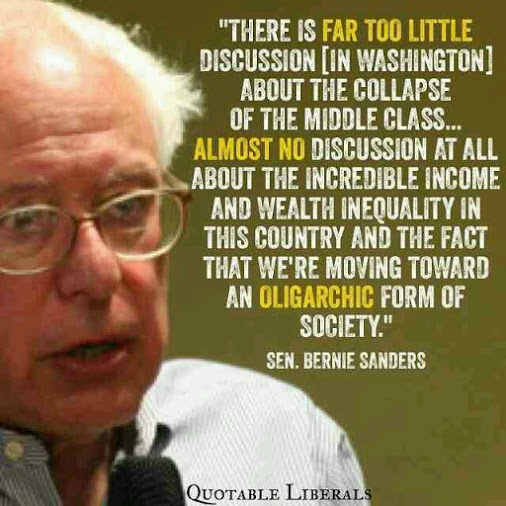
Question: Will taking the Internal Revenue Code back to how it was written in 1950 result in more tax revenue?
patches, Bernie - go!


Moderator: Community Team


Of course not. You know as well as I do, TGD, that no matter where the tax rate is set you still only get 19 or 20% of GDP.thegreekdog wrote:Question: Will taking the Internal Revenue Code back to how it was written in 1950 result in more tax revenue?
patches, Bernie - go!
You don't get deficits from cutting taxes, you get deficits from spending too much money! It doesn't matter what the tax rate is because you still get the same revenue no matter what. You wanna have budget surpluses, spend less money.Bernie Sanders wrote:I'llsettle for the tax rates during the Clinton Administration. At least the Federal budget was showing budget surplus. The Bush tax cuts increased the budget deficit.


Adjusted gross income / % of taxes paidAnd by design, wealthier Americans pay most of the nation’s total individual income taxes.
Are you claiming that by doing the above post will fulfill that first ground rule?thegreekdog wrote:(1) If we assume we want a balanced budget on a yearly basis (like most states have to do by the way), we have to have revenues equal to expenditures.
Have you taken into account the consequences of doing the bolded and will those consequences affect italics?thegreekdog wrote: Contention One: The high tax rate of 35% is a fallacy. Most companies do not pay a 35% tax rate in the United States because of various deductions and credits granted to them by Congressional authority. These deductions and credits are commonly referred to as loopholes by ignorant people. In reality, they are carefully crafted pieces of legislation to benefit companies for economic reasons. So, if we do away with deductions and credits and leave the 35% tax rate the way it is, more tax will flow into federal coffers.
thegreekdog wrote: Contention Two: Rich people don't pay enough tax. Most rich people pay a tax on capital gains which is generally imposed at a rate of 15%. As we see above, that is less than the 35% that corporations and individuals earning income over a certain amount, pay in tax. So, if we raise the rate on capital gains, rich people will pay more of their fair share.
You need both. You cannot just cut when the real prices of many things, ranging from the materials and labor needed to fix roads to medical costs for Medicaid recipients to, well... name something that has NOT gone up in price. I am not saying that this means a budget should not be curtailed, I am saying that this call to constantly "cut, cut, cut" has to be paired with either "do without" (and I mean us, not the esoteric, remote entity folks like to pretend makes government) or a raise in income to cover what must be spent. The bit about not raising the debt limit shows basic ineptitude. You don't cut your credit card costs by not paying them, unless you really want to file for bankruptcy. You stop charging new costs and pay more on the debt.patches70 wrote:You don't get deficits from cutting taxes, you get deficits from spending too much money! It doesn't matter what the tax rate is because you still get the same revenue no matter what. You wanna have budget surpluses, spend less money.Bernie Sanders wrote:I'llsettle for the tax rates during the Clinton Administration. At least the Federal budget was showing budget surplus. The Bush tax cuts increased the budget deficit.
lol.. saw this after I posted above. i might not be as set in my ways as you think. If you are referring to individuals, I actually would agree with you, to a point. If you refer to corporations, other businesses, then I don't necessarily. That said, I think the whole way we structure income tax (make that taxes in general) and what we use income tax to pay for is wrong.thegreekdog wrote:People making above $100,000 pay 77.7% of income taxes but file 15% of all tax returns.
So, rich people already pay the most taxes. By far. And, because Player is going to come in here soon, they do not use more government resources (or at least 15% of the people don't use 77.7% of the resources).
Discretionary spendingPLAYER57832 wrote: materials and labor needed to fix roads
player wrote: medical costs for Medicaid recipients
player wrote: That is the real issue here. Too many of the so-called "cuts" have really been paying less to the credit card companies, not really reducing costs. Just like when you only pay the minimum on your card, the cost passed on to each later administration keeps increasing.
player wrote: education,
The problem with "other business taxes" and corporate taxes is how they work. If a corporation pays tax on $1, that $1 will also eventually be taxed to an individual owning shares in that corporation. So that $1 is taxed twice. For "other business taxes" the tax cost is passed through to consumers in some fashion. So, it all falls on individuals at the end of the day. What Democrats allegedly want is for rich people to pay more taxes (or, alternatively, for the federal government to borrow more money). They will not get rich people to pay more taxes by taxing corporations (in my humble and novice opinion).PLAYER57832 wrote:lol.. saw this after I posted above. i might not be as set in my ways as you think. If you are referring to individuals, I actually would agree with you, to a point. If you refer to corporations, other businesses, then I don't necessarily. That said, I think the whole way we structure income tax (make that taxes in general) and what we use income tax to pay for is wrong.
thegreekdog wrote:Okay, since Bernie is not participating in this thread for some reason, I'm going to argue the case for higher taxes. Let's assume, even though it's definitely not true, that Bernie is not participating because he has no idea what he's talking about.
Caveats - I have simplified all of these things and disclaim any responsibility.
Contention One: The high tax rate of 35% is a fallacy. Most companies do not pay a 35% tax rate in the United States because of various deductions and credits granted to them by Congressional authority. These deductions and credits are commonly referred to as loopholes by ignorant people. In reality, they are carefully crafted pieces of legislation to benefit companies for economic reasons. So, if we do away with deductions and credits and leave the 35% tax rate the way it is, more tax will flow into federal coffers.
Contention Two: Rich people don't pay enough tax. Most rich people pay a tax on capital gains which is generally imposed at a rate of 15%. As we see above, that is less than the 35% that corporations and individuals earning income over a certain amount, pay in tax. So, if we raise the rate on capital gains, rich people will pay more of their fair share.
That's all I got. My (5) below, just so everyone knows...
http://www.pewresearch.org/fact-tank/20 ... o-be-fair/
Adjusted gross income / % of taxes paidAnd by design, wealthier Americans pay most of the nation’s total individual income taxes.
Less than $15,000 - 0.2%
$15,000 to $29,999 - 1.5%
$30,000 to $49,999 - 4.5%
$50,000 to $99,999 - 16.1%
We can stop here - people making between $0 and $99,999 pay 22.3% of income taxes but file 85% of all tax returns. Let's continue...
$100,000 to $199,999 - 22.7%
$200,000 to $249,999 - 6.1%
$250,000 and above - 48.9%
People making above $100,000 pay 77.7% of income taxes but file 15% of all tax returns.
So, rich people already pay the most taxes. By far. And, because Player is going to come in here soon, they do not use more government resources (or at least 15% of the people don't use 77.7% of the resources).
Nor have I.thegreekdog wrote:@patches - I'm not going to get into this discussion with you any more than I already have. The question I posed (even if not explicitly) was whether higher taxes would pay for spending. I have not seen any legislation considered by Congress that would do that.
OK, from the outset, I disagree with your lumping stocks, stock dividends and sales profits together. I also disagree with your assessment of "double tax", though its sort of a semantic discussion.thegreekdog wrote:The problem with "other business taxes" and corporate taxes is how they work. If a corporation pays tax on $1, that $1 will also eventually be taxed to an individual owning shares in that corporation. So that $1 is taxed twice. For "other business taxes" the tax cost is passed through to consumers in some fashion. So, it all falls on individuals at the end of the day. What Democrats allegedly want is for rich people to pay more taxes (or, alternatively, for the federal government to borrow more money). They will not get rich people to pay more taxes by taxing corporations (in my humble and novice opinion).PLAYER57832 wrote:lol.. saw this after I posted above. i might not be as set in my ways as you think. If you are referring to individuals, I actually would agree with you, to a point. If you refer to corporations, other businesses, then I don't necessarily. That said, I think the whole way we structure income tax (make that taxes in general) and what we use income tax to pay for is wrong.
I believe I do know the difference.patches70 wrote:
You might not realize, TGD does I bet, but it's important to know the difference between mandatory spending and discretionary spending.
Its not a question of more or less, its a question of changing our entire approach.patches70 wrote: The US could cut every single penny in discretionary spending, raise the marginal tax rate to 91% and it still wouldn't be enough to cover the entire mandatory spending.
They are, but that is a different issue, or sort of. I would say that the measures you use, that are being use to gauge this probably need to change. That is, how we measure GDP, economic growth (whether that, in and of itself, should even be a goal), etc are all in error to the point of not just being useless, of being actually harmful. Just as an example, minerals and natural resources not being used are not even counted and the profit from the sale of same does not take into account anywhere near the damage or ultimate costs from their use. That's not environmental poppycock or left wing blather, its reality. Its true conservatism to say that we need to START by making sure we are not increasing our future debt by ignoring problems. Intelligent people don't decide to use the walls or roof of their house for fuel, even if they are cold and hungry. If you are at the point when that seems logical, then you are already lost! Similarly, you cannot just decide not to pay for garbage pickup and let it accumulate in your house.. not for very long if you want to stay healthy, anyway. You can decide to compost and otherwise limit the garbage you put out. We have been very much making both types of errors in our economy --both burning our house for fuel and just deciding to ignore the garbage pile up. (literally and figuratively, both)patches70 wrote:
The FED is going to have no choice but soon to raise interest. Just a 1% increase to how much the government has to pay results in 100's of billions in additional interest payments and if the rates were at historic levels (around 6%) today the government would have to pay over $1trillion a year just on the interest payments on it's debt.
You do need to look beyond what you have been taught. NONE of the standard answers are going to work. We need to completely change our approach. When you are in debt up to your gills, you can declare bankruptcy, but unless you actually change what you do, most likely you will just wind up there again. Countries cannot really "go bankrupt". Or, when they do it is far more consequential, truly consequential than if you or I were to do so. It generally means war is not far behind.patches70 wrote:
Don't blame me, I didn't create this system.
No, I very much DO blame the politicians, and the people who keep electing them. I also blame our educational system, which is being more and more stripped of the science, particularly natural science, that provides the knowledge kids will need, that wee need, to truly solve these issues.patches70 wrote: Don't blame the politicians, they are just doing what the voters wanted. There is no one to blame, it just is what it is, reality and unsustainable no matter what fuzzy logic as you try to apply as "a little of both, cut and raise taxes". Ha!
There is only one way this ends. TGD knows it, don't ya TGD?
I don't think I lumped stocks, dividends, and sales profits together. I guess a basic understanding of the Internal Revenue Code is necessary here and I should not assume everyone knows it.PLAYER57832 wrote:OK, from the outset, I disagree with your lumping stocks, stock dividends and sales profits together. I also disagree with your assessment of "double tax", though its sort of a semantic discussion.
I think the tax code works that way to a certain extent. Non-cynics would say that the tax code also works as a public policy encouraging device. For example, we have non-profit entities (or exempt organizations). As another example, we have credits and deductions for environmentally friendly products and activities. Depending upon Congress or the president, these public policies may be different. However, most politicians want to encourage some sort of manufacturing and/or technology jobs. I find this weird since the US economy is mainly a service economy, but whatever.PLAYER57832 wrote:Our whole current tax structure is more or less based on the idea that we need to encourage production, use of resources, and sales of ... anything at all. My argument is that whole concept is just wrong, and this is far from just my idea.

Blaming the Federal Reserve Board for what?warmonger1981 wrote:Tax codes mean nothing when you have a Federal Reserve that dictates interest rates. Or maybe getting lobbyists out of government. This argument of 1950's tax code means nothing.
I can lump all the spineless Republicans together. They either tow the "trickle down economics" line or the extremists will run a far right candidate against them.warmonger1981 wrote:Obviously Bernie has no understanding of the Federal Reserve and its power. I notice you lump all Republicans in one box and only SOME of the Democrats as being corporate whores. So if something seems impossible do nothing? Just sit there and hold ones breathe? It's funny acting like returning the tax code to the 1950's style will do anything. One must go to the root of the problem. The problem is a private bank lending money to a country with interest. Silly old man. Your Woodrow Wilson style of progressivism is dead.
The only thing I wasted was about a tablespoon worth on your mothers lips.