
Agreed.armati wrote:there would be a revolution before tomorrow morning.


Moderator: Community Team
Agreed.armati wrote:there would be a revolution before tomorrow morning.
Napoleon Ier wrote:You people need to grow up to be honest.
Well they are related aren't they? you don't consider debt slavery as a loss of personal freedom?notyou2 wrote:Glad my post about loss of personal freedoms in the US has sparked such a lively debate on currencies and inflation.


Fair enough, we need not agree. But by your own standards here I think clean water is better than dirty water that gets you sick (which we have now vs then). As someone who is overly familiar with wine, I can tell you quite definitively that wine is better in virtually every way now than it was in Roman times. Is wine better now than 300 years ago? that is debatable, but now vs 2000 years ago it's not even close. there are huge problems in the way they made wine back then such as inconsistent ripeness, Rot, fungus, volatile acidity, brettanomyces among other things tend to make wine smell and taste bad. Virtually all of these things are nolonger a problem even in $2 wine from TraderJoes now.patches70 wrote:Oh, I'm not entirely convinced about that. Wine, beer ale in olden times was quite different than it is today. Those types of drinks are probably the only reason human beings survived to even make it to today. We learned to distill alcohol and it was one of the most important inventions ever, because before that you'd have to drink from a stream, a lake, a stagnated pool of cess water if you had to, and that could and would get you sick and all too often you'd die.mookiemcgee wrote:
Well I absolutely agree that they serve the same purpose, I do disagree about the quality level and I personally don't really think that is subjective. Wine 2000 years ago was just bad, sure it got you drunk just as well but it was painful and gross to drink. Wine is just straight up better and more enjoyable (and will get you drunk much more effectively) than what they drank back then!
sure, the alcohol tasted a lot different, by your standards "bad" but people didn't drink those things with the intention of having fun, they drank it because it was the only thing safe to drink. Their alcohol was much more hearty, nutritious than our stuff today which is now relegated to a luxury product for the most part. We are more tech advanced than our ancestors, but we sometimes forget they were just as smart as we are today, they had the same brains we have. It just takes a long time since discoveries are built upon prior discoveries. We've reached a point where our sum total of knowledge is just vast compared to our forebearers, but don't let that make you think we are better or smarter than they were. We aren't.
But good discussion none the less! We need not agree.

Lootifer! Nice!Lootifer wrote:Patches, we’ve talked, before. You know this isn’t my first rodeo (I battled with BBS back in the day).
I’ll read your dialog, but you can assume I have a pretty sound knowledge of economics (although my macro is a bit weak, hence the question). I know what inflation is lol, Amarati.
I’ll reply later (since I too have work to do).

Just like psychology, anthropology and other social sciences arrn’t Science amirite?!armati wrote: 2. Economics is not a science
.
Napoleon Ier wrote:You people need to grow up to be honest.
Hey man, I hope you are well.thegreekdog wrote:
Lootifer! Nice!
I should have clarified, good information, most of which I agree with. But you didn't need to write it all out.patches70 wrote:
yes I can do that for you. Sorry for taking so long, some of us gotta work.
Anyway, to understand why fiat currencies directly affect purchasing power of families (adversely) you have to accept a couple of facts first.
First fact, everything is cheaper now than ever before in human history...
*snip*
...Our work today is priced in a fiat currency which lowers in value every time a new dollar is introduced into the market.
Now this should answer your question and you are welcome to research this on your own to confirm what I am saying, I encourage you to do so because it's a rabbit hole that will open up a whole new way of thinking about the world.
This is an interesting theory, and one I will think more on. My take on the wealth disparity is kinda similar, but kind of different: Those who have wealth now can find more wealth far easier (through access to capital) than those who have no capital.patches70 wrote: But until then, let me let you in on something that's gonna make you mad, and illustrate one of the bad consequences of fiat money. You see, the market doesn't react instantly. When you introduce new money into the market it takes some time for the market to adjust and and reflect the lesser value of all the money in the market as a consequence of the new money added. What is going to make you mad about this is that the way new money is introduced and who benefits from it. You see, as Armati said I think, new money most often comes in the form of fractional reserve lending. When a bank loans money it doesn't have that money on hand, it literally creates that money out of thin air and it's legal. A bank in the US only needs to hold 10% reserves for all the money they lend out. Now when the bank creates this money the market hasn't seen this yet and so it hasn't been priced in yet. Thus, whomever it was that got the loan gets the full value of that new currency and buys things at a rate that is less than after the market adjusts to the new quantity of currency. Poor people aren't getting loans, are they? Yet, it is the little money poor people have that get hurt the most when the market prices in this new money and the poor people all of a sudden have less purchasing power than that meagerly had before. This is the so called "wealth disparity" we all hear so much about. It is the rich who take out loans and buy up stuff before that new currency suffers from inflation.
There is nothing inherently unsustainable about exponential growth, only material constraints in the environment the growth is operating in cause issues. And since fiat is inherently immaterial I am struggling to find an issue (with the growth itself, I am certainly not suggesting fiat currency doesn't have issues!!).patches70 wrote: It's just how the system works, and it's a fine system is your goal is exponential growth, but we already know from basic math classes that exponential growth of anything is unsustainable, and this includes fiat currency.
Edit: Oops, forgot to address this:patches70 wrote: What's worse is the Fed has a target inflation rate of 2% a year, and as we already know when you have some like "x% growth over a given period of time = exponential growth". Thus, you see the effects on the above graph. And that's just the Fed's target rate for the macro economy, when you look at specific industries you'll find more disturbing inflation. Armati is correct, 2% growth a year equals a doubling of the price every 35 years. *healthcare example*
*college tuition example*
*housing example*
This is the link I don't really see. I see issues in modern society, for sure, but I don't see a causal link between inflation, and wealth disparity.patches70 wrote: And all the while average people who don't know how to take advantage of the fiat system suffered the most. (*snipped rest as this is key point*)
If failing to predict the exact date of the next stock market crash is to be taken as evidence that economics is not a science, then nothing is a science.armati wrote:Economics is not a social science
by Brian Davey
"As Yves Smith makes clear, the status and power of economics and economists is connected to its claim to be a social science. So let’s be clear…..it is no such thing.
What is currently taught as economics cannot possibly be described either as a science or even, for that matter, as a study of society. I make that assertion because the track record of economists in prediction is so poor that it is laughable for them to claim scientific status. This failure of predictive power has been pointed out over and over again – particularly after the failure of the bulk of the economics profession to predict the collapse of 2007/8. http://www.prophetsprofit.com.au/dismal.htm"
http://www.feasta.org/2011/10/05/econom ... l-science/
Thats just a piece of the article, there were a few authors to choose from.
I believe this author points out our economists never seem to get it right, which is a kind of indicator its not science.
But in any case, ive been talking economics with some pretty bright people for the last 10-15 years or so and as I said to Patches, I have found the economic discussion goes round and round.
Seems for every point there is a counter point, so Im gonna let you guys draw your swords and shoot each other for awhile.
Its a good topic tho and Im happy to see opinions posted.
I feel like you, and the text you have cited, are conflating policy advisors and econometric forecasters with the body of work that is economics. I am neither (although guilty of using econometric forecasts), yet I would call myself an economist.armati wrote:Economics is not a social science
by Brian Davey
"As Yves Smith makes clear, the status and power of economics and economists is connected to its claim to be a social science. So let’s be clear…..it is no such thing.
What is currently taught as economics cannot possibly be described either as a science or even, for that matter, as a study of society. I make that assertion because the track record of economists in prediction is so poor that it is laughable for them to claim scientific status. This failure of predictive power has been pointed out over and over again – particularly after the failure of the bulk of the economics profession to predict the collapse of 2007/8. http://www.prophetsprofit.com.au/dismal.htm"
http://www.feasta.org/2011/10/05/econom ... l-science/
Thats just a piece of the article, there were a few authors to choose from.
I believe this author points out our economists never seem to get it right, which is a kind of indicator its not science.
But in any case, ive been talking economics with some pretty bright people for the last 10-15 years or so and as I said to Patches, I have found the economic discussion goes round and round.
Seems for every point there is a counter point, so Im gonna let you guys draw your swords and shoot each other for awhile.
Its a good topic tho and Im happy to see opinions posted.
Somebody posted some economic data. Posting economic data tends to summon one of Alex Jones' minions to come out of the ether and post "economics is not a science!"thegreekdog wrote:I'm sure I've missed it, but why does it matter whether economics is a science?
But economic data is just data... information... facts.Dukasaur wrote:Somebody posted some economic data. Posting economic data tends to summon one of Alex Jones' minions to come out of the ether and post "economics is not a science!"thegreekdog wrote:I'm sure I've missed it, but why does it matter whether economics is a science?
This is accurate if by "ether" you mean "the variety of authoritarian, xenophobic, and anti-semetic havens we call 'the threads in the off-topic forum.'"Dukasaur wrote:Somebody posted some economic data. Posting economic data tends to summon one of Alex Jones' minions to come out of the ether and post "economics is not a science!"thegreekdog wrote:I'm sure I've missed it, but why does it matter whether economics is a science?
Napoleon Ier wrote:You people need to grow up to be honest.
I don't disagree. But this is the world that collaborative filtering has left us.thegreekdog wrote:But economic data is just data... information... facts.Dukasaur wrote:Somebody posted some economic data. Posting economic data tends to summon one of Alex Jones' minions to come out of the ether and post "economics is not a science!"thegreekdog wrote:I'm sure I've missed it, but why does it matter whether economics is a science?
Napoleon Ier wrote:You people need to grow up to be honest.
Oh, you are absolutely right, The rich do have far better access to capital. And usually that capital comes in the form of low interest loans, the rich don't use their own money to finance things after all. This is why my above question is important if we are going to get anywhere. If we agree that money (and credit, I should have said) drive inflation, then you have to accept that those who get the loan from credit conjured up from thin air from a bank, then you have to acknowledge that until the person starts spending that new money the market hasn't yet registered it's existence. When that money is finally recognized the market reacts and we see that reaction in the form of inflation. But the person who used that money first, uses it at pre market reaction, almost everyone else who uses that money later loses the value the original person had because by that time the market has reacted and decreased the value of that new money.Lootifer wrote:
This is an interesting theory, and one I will think more on. My take on the wealth disparity is kinda similar, but kind of different: Those who have wealth now can find more wealth far easier (through access to capital) than those who have no capital.
Oh I gotta disagree. exponential growth is only sustainable if you have infinite time, resources and space (for material things that grow exponentially, like germs and bacterias). The market certainly isn't capable of infinite growth, there is always crashes and corrections that interrupt such growth because it literally can't go on forever. And this is true for anything, not just finance. It's almost always this very thing that ends up destroying fiat currencies in the end. You can print all you want but eventually everyone is going to lose faith and that's it for the currency, it's done. Just as Zimbabwe or Venezuela for the most recent example. Inflation has not only destroyed Venezuela's economy it's also destroying their very society. And absolutely, their government policies certainly didn't help the situation, they certainly didn't pay enough attention to economic realities I'd say.loot wrote:
There is nothing inherently unsustainable about exponential growth, only material constraints in the environment the growth is operating in cause issues. And since fiat is inherently immaterial I am struggling to find an issue (with the growth itself, I am certainly not suggesting fiat currency doesn't have issues!!).
I gotta disagree a bit, government policies can certainly cause problems, bu I'm not talking about government policies, because when you start factoring those in everything starts getting really really complication with cause and effects that are sometimes foreseen and sometimes unforeseen. What I'm talking about is strictly the policies of The Federal Reserve, which contrary to popular belief isn't a government agency under control of government lawmakers. The Federal Reserve calls itself "an independent government agency" but that's not really the case. The President appoints the chair of the Fed but the board is decided by the Fed itself. Fed policies don't require approval from the Administrative or Legislative branches of government. Show me a single government agency that isn't under the control of a branch of government?loot wrote:
Edit: Oops, forgot to address this:
Those are all examples of government policies, and not the monetary policy itself. And when you make change, there will be short term shocks - that's what happens with change. This is also why 3-4 year terms for both politicians and CEOs are generally a bad idea, as their incentive is to game these shocks (lots of short term gains, avoidance short term losses), without thinking about long term implications (which often are the opposite, short term gains turn into long term losses, and vice versa for short term losses).
The macro inflation rate during that time might have been 2.7%, One problem you've got is that in your stretch of years you are combining 1984-1989 with 1990-2016. This is a bad idea, why? Because in 1990 the US government changed the way it calculates inflation. Previous to 1990 the government changed the way they calculate inflation in 1980 as well. When you start comparing you have to show this, like this-loot wrote:
This is the link I don't really see. I see issues in modern society, for sure, but I don't see a causal link between inflation, and wealth disparity.
For example, using FRED (handy source of economic data, I hope it is reputable), inflation from 1984 to 2016 averaged around 2.7%. Conversely, median household income has risen on average around 3.1%. In other words, real incomes have gone up.
Getting paid $20, when bread costs $0.2 is the same as getting paid $200, with bread @ $2 (and getting paid $2000, with bread @ $20!).


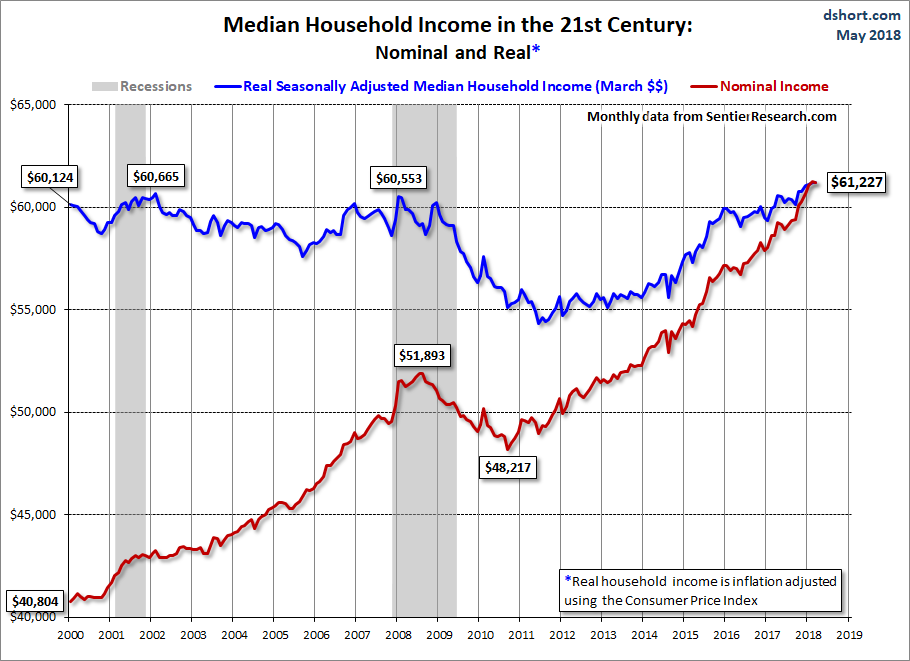
you have the census bureau warning you can't compare figures with previous years before 2013 as the methodology changed to an extent as to increase measured incomes. If they'd kept using the same methodology then you see we still haven't even gotten back to 1999 levels.article wrote:But Census Bureau officials cautioned that those figures were not directly comparable because of a change in its methodology in 2013 that has tended to increase measured incomes.
The Economic Policy Institute, a liberal research organization based in Washington, estimated that without the change in methodology, median household income in 2016 was still 2.4 percent lower than in 1999 — and 1.6 percent below the level reached in 2007, before the recession began.
Yeah, I forgot. I know we've talked before but I can't remember any of the substance of those talks. Old age, it's a bitch. I'm just fascinated with the subject. I think, and I believe you'd agree, no matter what the economic system is, it is wise and good to get out of debt and stay out of debt if at all possible. Life is easier without having to pay back debts, don't ya think?Lootifer wrote:Patches, we’ve talked, before. You know this isn’t my first rodeo (I battled with BBS back in the day).
I’ll read your dialog, but you can assume I have a pretty sound knowledge of economics (although my macro is a bit weak, hence the question). I know what inflation is lol, Amarati.
I’ll reply later (since I too have work to do).
Every economics textbook will tell you that it's a descriptive science. It's not there to answer normative questions.Neoteny wrote:The problem with modern economics is plainly political bias. It deals in numbers and data but there is no real knowledge-base gleaned from it as far as for predicting/explaining trends and applying the field to policy. If you think wealth should be allowed to flow freely, there are models to drift toward that may loosely match reality, and if you are interested in egalitarian wealth distribution, then you can find the same there. I wouldn't rule out that it could be a science, but I don't think we're there now.