

Global Warming will cause a Harsh Winter...wait what..?
Moderator: Community Team
Forum rules
Please read the Community Guidelines before posting.
Please read the Community Guidelines before posting.

-
tzor
- Posts: 4076
- Joined: Thu Feb 22, 2007 9:43 pm
- Gender: Male
- Location: Long Island, NY, USA
- Contact:
Re: Global Warming will cause a Harsh Winter...wait what..?
I'm going to highlight something because it's a perfect example of when you drift from the realm of "facts."
The notion that the rate is high ("fast") is an opinion.
Trust me, I'm a former physics major, I studied relativity.
In fact the last time the CO2 rate was this high was 4 million years ago, before man. So about that temperature thing ...
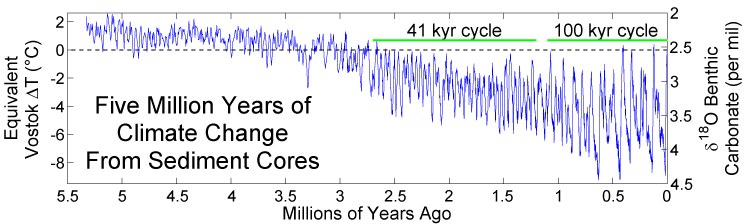
Now we get to an interesting fact you mention ... "Forests are disappearing." But here the problem is man cutting down the forest, not as a direct cause of climate change. In Africa, wood is still used for fuel; bad to the trees but I don't think comparable to the coal based emissions from China.
So back to the measurable facts. Facts are meaningless unless put into context. Unfortunately, at this time, context is often assumed from personal bias.
P.S. CO2 and trees are not really all that they make themselves to be; breathe in and breathe out. CO2 absorption from algae might prove to be the key element in the long term. In fact, we might have more personal algae scrubbers on our rooftops than solar panels in a couple of decades. Hmmmm ... bio-diesel.
The planet is heating up is a "fact."Dukasaur wrote: No, the facts are undeniable enough. The planet is heating up fast. The amount of CO2 in the atmosphere is likewise increasing fast. Forests are disappearing. Etc., etc. These things are measurable facts.
The notion that the rate is high ("fast") is an opinion.
Trust me, I'm a former physics major, I studied relativity.
In fact the last time the CO2 rate was this high was 4 million years ago, before man. So about that temperature thing ...
Wait, what? We're like freezing compared to what was then. If you base everything on CO2 then we are already underwater but we are not. Temperatures are well below what they were 4 million years ago ...reconstruction of the past 5 million years of climate history, based on oxygen isotope fractionation (serving as a proxy for the total global mass of glacial ice sheets). See the discussion below for a summary of the methods and models used. Note that in 2010, User:SeL media switched the orientation of the time axis and the vertical axes, apparently without discussion, and some descriptions of the image may refer to the older version, resulting in confusion of 'right' and 'left' in the image.
Now we get to an interesting fact you mention ... "Forests are disappearing." But here the problem is man cutting down the forest, not as a direct cause of climate change. In Africa, wood is still used for fuel; bad to the trees but I don't think comparable to the coal based emissions from China.
So back to the measurable facts. Facts are meaningless unless put into context. Unfortunately, at this time, context is often assumed from personal bias.
P.S. CO2 and trees are not really all that they make themselves to be; breathe in and breathe out. CO2 absorption from algae might prove to be the key element in the long term. In fact, we might have more personal algae scrubbers on our rooftops than solar panels in a couple of decades. Hmmmm ... bio-diesel.

-
jusplay4fun

- Posts: 8476
- Joined: Sun Jun 16, 2013 8:21 pm
- Gender: Male
- Location: Virginia
Re: Global Warming will cause a Harsh Winter...wait what..?
NomadP wants to debate the entire issue of Global Warming on a phrase he brings up and tries to accuse others of being wrong because, allegedly, they do not understand or they misuse this phrase:
https://climate.nasa.gov/evidence/
Your arguments are weak, your logic is lacking, your thinking is limited and narrow, and you are simply wrong on this issue, nomadP.
JP
NomadP wants to ignore the preponderance of the evidence that points to man's use of fossil fuels as the most likely cause of 1) increased levels of CO2, carbon dioxide; 2) increased levels of other greenhouse gases; 3) the link between increased greenhouse gases and the increase in temperature in nearly all zones; 4) that if this increase were natural, a significant decrease in some weather zones would be apparent; 5) the massive evidence of global warming as shown by (among many): a) shrinking (melting) ice caps; b) shrinking glaciers; c) data bases showing increase in temperatures in the past 60+ years; d) rising sea levels; e) more.Global Warming is .. ' Settled Science".. isn't it. ?
https://climate.nasa.gov/evidence/
Your arguments are weak, your logic is lacking, your thinking is limited and narrow, and you are simply wrong on this issue, nomadP.
JP
-
jusplay4fun
- Posts: 8476
- Joined: Sun Jun 16, 2013 8:21 pm
- Gender: Male
- Location: Virginia
Re: Global Warming will cause a Harsh Winter...wait what..?
Tzor said:
I would offer this argument: one needs to look at the preponderance of the evidence and not argue minutia.
https://climate.nasa.gov/causes/
https://climate.nasa.gov/vital-signs/gl ... mperature/
I will add one more point, for now:
Since I too am a former Physics major, does that mean my opinion is also equally valid and relative?Trust me, I'm a former physics major, I studied relativity.
I would offer this argument: one needs to look at the preponderance of the evidence and not argue minutia.
https://climate.nasa.gov/causes/
https://climate.nasa.gov/vital-signs/gl ... mperature/
I will add one more point, for now:
JP4FHow do we know that changes in the Sun aren’t to blame for current global warming trends?
Since 1978, a series of satellite instruments have measured the energy output of the Sun directly. The satellite data show a very slight drop in solar irradiance (which is a measure of the amount of energy the Sun gives off) over this time period. So the Sun doesn't appear to be responsible for the warming trend observed over the past several decades.

Re: Global Warming will cause a Harsh Winter...wait what..?
tzor, what it's very interesting, here and in other discussions.. is how easily you convince yourself of whatever you want. i really think it's a talent. because you seem like a genuinely good guy i don't think you're really trolling, you're not trying either to convince others of what you aren't convinced.. you are convincing yourself first.. it's like.. you'd fall for your own most simple magic tricks.. not sure i'm painting the picture correctly.. but like.. you could throw a coin behind your back and then ask yourself "where did it go?" and be honestly amused.tzor wrote:I'm going to highlight something because it's a perfect example of when you drift from the realm of "facts."
The planet is heating up is a "fact."Dukasaur wrote: No, the facts are undeniable enough. The planet is heating up fast. The amount of CO2 in the atmosphere is likewise increasing fast. Forests are disappearing. Etc., etc. These things are measurable facts.
The notion that the rate is high ("fast") is an opinion.
Trust me, I'm a former physics major, I studied relativity.
In fact the last time the CO2 rate was this high was 4 million years ago, before man. So about that temperature thing ...
Wait, what? We're like freezing compared to what was then. If you base everything on CO2 then we are already underwater but we are not. Temperatures are well below what they were 4 million years ago ...reconstruction of the past 5 million years of climate history, based on oxygen isotope fractionation (serving as a proxy for the total global mass of glacial ice sheets). See the discussion below for a summary of the methods and models used. Note that in 2010, User:SeL media switched the orientation of the time axis and the vertical axes, apparently without discussion, and some descriptions of the image may refer to the older version, resulting in confusion of 'right' and 'left' in the image.
Now we get to an interesting fact you mention ... "Forests are disappearing." But here the problem is man cutting down the forest, not as a direct cause of climate change. In Africa, wood is still used for fuel; bad to the trees but I don't think comparable to the coal based emissions from China.
So back to the measurable facts. Facts are meaningless unless put into context. Unfortunately, at this time, context is often assumed from personal bias.
P.S. CO2 and trees are not really all that they make themselves to be; breathe in and breathe out. CO2 absorption from algae might prove to be the key element in the long term. In fact, we might have more personal algae scrubbers on our rooftops than solar panels in a couple of decades. Hmmmm ... bio-diesel.
not the first time i notice this. i saw it again yesterday in your attempt at sophism. but i have seen it many times before.
life is boring anyway. who cares who's right. f*ck that, i'm right.
i, candidly think it's a true talent. something good.
(this is not to be confused with the "fake news!!" umbrella, or "my dad is my brother" kind of stuff)
el cartoncito mas triste del mundo
-
tzor
- Posts: 4076
- Joined: Thu Feb 22, 2007 9:43 pm
- Gender: Male
- Location: Long Island, NY, USA
- Contact:
Re: Global Warming will cause a Harsh Winter...wait what..?
No, but hopefully you should know the difference between a "fact" and an "opinion" and "fast" isn't a "fact."jusplay4fun wrote:Since I too am a former Physics major, does that mean my opinion is also equally valid and relative?
Here is the problem; humans do a lot of shit all the time. The environmental shit we have done in the past few decades to atone for the shit we did in the previous century could equally be the cause of temperature variations in the relatively short term interval of decades. And since we are citing NASA these days (even though they have gone PC crazy and I'm skeptical of anything post George M Lowe but whatever)
Aerosols and Incoming Sunlight (Direct Effects)
Here is a better article from January, New calculations show scientists have grossly underestimated the effects of air pollutionScientists believe the cooling from sulfates and other reflective aerosols overwhelms the warming effect of black carbon and other absorbing aerosols over the planet. Models estimate that aerosols have had a cooling effect that has counteracted about half of the warming caused by the build-up of greenhouse gases since the 1880s. However, unlike many greenhouse gases, aerosols are not distributed evenly around the planet, so their impacts are most strongly felt on a regional scale.
The fact that our planet is getting warmer even though aerosols are cooling it down at higher rates than previously thought brings us to a Catch-22 situation: Global efforts to improve air quality by developing cleaner fuels and burning less coal could end up harming our planet by reducing the number of aerosols in the atmosphere, and by doing so, diminishing aerosols' cooling ability to offset global warming.
According to Rosenfeld, another hypothesis to explain why Earth is getting warmer even though aerosols have been cooling it down at an even a greater rate is a possible warming effect of aerosols when they lodge in deep clouds, meaning those 10 kilometers or more above the Earth. Israel's Space Agency and France's National Centre for Space Studies (CNES) have teamed up to develop new satellites that will be able to investigate this deep cloud phenomenon, with Professor Rosenfeld as its principal investigator.
Either way, the conclusion is the same. Our current global climate predictions do not correctly take into account the significant effects of aerosols on clouds on Earth's overall energy balance. Further, Rosenfeld's recalculations mean fellow scientists will have to rethink their global warming predictions -- which currently predict a 1.5 to 4.5-degree Celsius temperature increase by the end of the 21st century -- to provide us a more accurate diagnosis -- and prognosis -- of the Earth's climate.
-
NomadPatriot
- Posts: 2717
- Joined: Thu Oct 04, 2018 7:33 pm
- Location: Self-Sufficient Fortress America
Re: Global Warming will cause a Harsh Winter...wait what..?
so is outer space in general all the same temperature..? say universe wide..?tzor wrote:No, but hopefully you should know the difference between a "fact" and an "opinion" and "fast" isn't a "fact."jusplay4fun wrote:Since I too am a former Physics major, does that mean my opinion is also equally valid and relative?
Here is the problem; humans do a lot of shit all the time. The environmental shit we have done in the past few decades to atone for the shit we did in the previous century could equally be the cause of temperature variations in the relatively short term interval of decades. And since we are citing NASA these days (even though they have gone PC crazy and I'm skeptical of anything post George M Lowe but whatever)
Aerosols and Incoming Sunlight (Direct Effects)
because our solar system is moving through Milky Way pretty fast. & in turn the Milky Way is also moving through the universe at a very high rate of speed as well..
could there be warmer sectors or "hot spot' of space in our galaxy our solar system is moving through currently.. like say our Solar System is now moving through a sector of space where a star once was.. thus the general temperature of the sector of space where that star once was is warmer in general then the surrounding space
( I know.. it's just a Theory. but all science is a Theory.. so if one Theory is valid.. then all theories are valid.. )

-
tzor
- Posts: 4076
- Joined: Thu Feb 22, 2007 9:43 pm
- Gender: Male
- Location: Long Island, NY, USA
- Contact:
Re: Global Warming will cause a Harsh Winter...wait what..?
First of all, the Solar "wind" caused by the ejection of gasses from the Sun goes out beyond the orbits of the known planets (Voyager five years ago passed the boundary) and effectively the interstellar medium is pushed away by it. The distance is around 121 AU.NomadPatriot wrote:so is outer space in general all the same temperature..? say universe wide..?
Never the less, there is only two ideas of temperature especially as it related to transfer of temperature. There are two means radiation and conduction. Unless you are really hot, it takes a long while to radiate your heat. Likewise the thinness of space makes it hard to conduct heat to an adjacent body.
So both in terms of conduction and convection, the sun has the greatest influence. Conduction gets complicated because of the effect of the magnetosphere pushing away the wind in the same way the solar wind pushes away the interstellar wind.
Currently we pass though spiral arms in the galaxy every 100 million years and spend about 10% of that time in the arm. We are currently in the Orion spur. That's generally beyond the normal calculations of weather patterns.

-
jusplay4fun
- Posts: 8476
- Joined: Sun Jun 16, 2013 8:21 pm
- Gender: Male
- Location: Virginia
Re: Global Warming will cause a Harsh Winter...wait what..?
Discussion of solar wind in this context is complete obfuscation.
Talk about CO2 levels and actual temperature measurements that show warming planet. Talk about shrinking ice caps and glaciers. You can simply look at pictures of the same place from the same vantage point at the same time of year and see the shrinkage, without fancy measurements, if it is too complex to deal with measurements. Too much obfuscation of facts is present below.
Talk about CO2 levels and actual temperature measurements that show warming planet. Talk about shrinking ice caps and glaciers. You can simply look at pictures of the same place from the same vantage point at the same time of year and see the shrinkage, without fancy measurements, if it is too complex to deal with measurements. Too much obfuscation of facts is present below.
tzor wrote:First of all, the Solar "wind" caused by the ejection of gasses from the Sun goes out beyond the orbits of the known planets (Voyager five years ago passed the boundary) and effectively the interstellar medium is pushed away by it. The distance is around 121 AU.NomadPatriot wrote:so is outer space in general all the same temperature..? say universe wide..?
Never the less, there is only two ideas of temperature especially as it related to transfer of temperature. There are two means radiation and conduction. Unless you are really hot, it takes a long while to radiate your heat. Likewise the thinness of space makes it hard to conduct heat to an adjacent body.
So both in terms of conduction and convection, the sun has the greatest influence. Conduction gets complicated because of the effect of the magnetosphere pushing away the wind in the same way the solar wind pushes away the interstellar wind.
Currently we pass though spiral arms in the galaxy every 100 million years and spend about 10% of that time in the arm. We are currently in the Orion spur. That's generally beyond the normal calculations of weather patterns.
-
tzor
- Posts: 4076
- Joined: Thu Feb 22, 2007 9:43 pm
- Gender: Male
- Location: Long Island, NY, USA
- Contact:
Re: Global Warming will cause a Harsh Winter...wait what..?
I know, but it's fun obfuscation.jusplay4fun wrote:Discussion of solar wind in this context is complete obfuscation.
-
jusplay4fun
- Posts: 8476
- Joined: Sun Jun 16, 2013 8:21 pm
- Gender: Male
- Location: Virginia
Re: Global Warming will cause a Harsh Winter...wait what..?
I think I JUS now heard someone concede the debate. Thanks for all the FUN, Tzor.
JP4Fun
JP4Fun
tzor wrote:I know, but it's fun obfuscation.jusplay4fun wrote:Discussion of solar wind in this context is complete obfuscation.
-
jonesthecurl

- Posts: 4625
- Joined: Sun Mar 16, 2008 9:42 am
- Gender: Male
- Location: disused action figure warehouse
- Contact:
Re: Global Warming will cause a Harsh Winter...wait what..?
Well, to be fair, Tzor was just replying to NoPoint's ridiculous "maybe it's space that's getting warmer" idea.
instagram.com/garethjohnjoneswrites
-
tzor
- Posts: 4076
- Joined: Thu Feb 22, 2007 9:43 pm
- Gender: Male
- Location: Long Island, NY, USA
- Contact:
Re: Global Warming will cause a Harsh Winter...wait what..?
What debate did I concede, because my last point was that galactic conditions have squat to do with earth conditions.
My argument has always been that man has been doing a lot of things. CO2 is only one of those things and that unless we look at the whole picture we can't properly understand what we are doing and what we might need to do to solve the problem. Youtube is a great resource to realize that at the geological scale, real shit happens. The Sahara dessert wasn't a desert only some 5,000 or some years ago. Yet today, that desert supplies important fertilizer to the Amazon across the Atlantic. And it may have been a COLD PERIOD that turned the tropical paradise into total sand wastes.
And that has always been my point. Our knowledge is limited but computer models (like my wonderful freshman physics classes where we assumed frictionless planes) make assumptions that don't reflect the real world. Making blanket arguments from the models alone could easily be a recipe for disaster.
My argument has always been that man has been doing a lot of things. CO2 is only one of those things and that unless we look at the whole picture we can't properly understand what we are doing and what we might need to do to solve the problem. Youtube is a great resource to realize that at the geological scale, real shit happens. The Sahara dessert wasn't a desert only some 5,000 or some years ago. Yet today, that desert supplies important fertilizer to the Amazon across the Atlantic. And it may have been a COLD PERIOD that turned the tropical paradise into total sand wastes.
And that has always been my point. Our knowledge is limited but computer models (like my wonderful freshman physics classes where we assumed frictionless planes) make assumptions that don't reflect the real world. Making blanket arguments from the models alone could easily be a recipe for disaster.
Re: Global Warming will cause a Harsh Winter...wait what..?
"maybe it's space that's getting warmer"
/thread
/thread
el cartoncito mas triste del mundo
-
NomadPatriot
- Posts: 2717
- Joined: Thu Oct 04, 2018 7:33 pm
- Location: Self-Sufficient Fortress America
Re: Global Warming will cause a Harsh Winter...wait what..?
"another species flushed down the tubes, we need another Race to Rape".. ??riskllama wrote:

this is what Llama listens to in his igloo--> long haired shirtless Muscular Guys wearing tight pants talking about raping entire races of people. ..

Re: Global Warming will cause a Harsh Winter...wait what..?
lol, NP must've missed the Jessica Hahn cameo...*shrugs*

-
NomadPatriot
- Posts: 2717
- Joined: Thu Oct 04, 2018 7:33 pm
- Location: Self-Sufficient Fortress America
Re: Global Warming will cause a Harsh Winter...wait what..?
whatever 'keeps you warm' at night I guess..riskllama wrote:lol, NP must've missed the Jessica Hahn cameo...*shrugs*
-
NomadPatriot
- Posts: 2717
- Joined: Thu Oct 04, 2018 7:33 pm
- Location: Self-Sufficient Fortress America
Re: Global Warming will cause a Harsh Winter...wait what..?
is that the Canadian Politically Correct terminology for what 'keeps you warm at night" when your watching music videos with scantily clad former Playboy models in them.. ?riskllama wrote:global warming?
do not Globally Warm yourself often...
-
jusplay4fun
- Posts: 8476
- Joined: Sun Jun 16, 2013 8:21 pm
- Gender: Male
- Location: Virginia
Re: Global Warming will cause a Harsh Winter...wait what..?
If that is the case, why did Tzor quote me?
And I agree, the space argument had no bearing.
And back to Tzor, yes, we cannot know it all. But assuming a frictionless situation gets us starting to understand motion. Nothing is perfect in the study of the real world. Take the forecast for hurricane Dorian; we do not know exactly where it will go, but we can describe very probable paths for its motion.
JP4F
And I agree, the space argument had no bearing.
And back to Tzor, yes, we cannot know it all. But assuming a frictionless situation gets us starting to understand motion. Nothing is perfect in the study of the real world. Take the forecast for hurricane Dorian; we do not know exactly where it will go, but we can describe very probable paths for its motion.
JP4F
jonesthecurl wrote:Well, to be fair, Tzor was just replying to NoPoint's ridiculous "maybe it's space that's getting warmer" idea.
-
tzor
- Posts: 4076
- Joined: Thu Feb 22, 2007 9:43 pm
- Gender: Male
- Location: Long Island, NY, USA
- Contact:
Re: Global Warming will cause a Harsh Winter...wait what..?
That's because the direction a hurricane goes is mostly dependent on the major air masses around it (as well as ocean/land conditions) , something that can be roughly modeled to an extent.jusplay4fun wrote:Take the forecast for hurricane Dorian; we do not know exactly where it will go, but we can describe very probable paths for its motion.
The problem is that the major factors to climate in general are not known to that degree, which is why most if not all models on long term climate generate completely inaccurate predictions. In addition, the time scale of climate change is go much longer that those minor factors start to play significant roles.
-
jusplay4fun
- Posts: 8476
- Joined: Sun Jun 16, 2013 8:21 pm
- Gender: Male
- Location: Virginia
Re: Global Warming will cause a Harsh Winter...wait what..?
Tzor is correct on his first point, basically about steering currents (of major air masses).
Tzor is incorrect to state the because weather forecasting is subject to much uncertainty, thus climate forecasting is also (or even more so) less predictable.
I offer the following argument. I first noticed this when reading Isaac Asimov's Foundation Trilogy:
Here is another quote:
Tzor is incorrect to state the because weather forecasting is subject to much uncertainty, thus climate forecasting is also (or even more so) less predictable.
I offer the following argument. I first noticed this when reading Isaac Asimov's Foundation Trilogy:
I will offer one paraphrase: "While one cannot predict specific behaviors a day's weather, the overall climate is more predictable."the mathematician Hari Seldon spends his life developing a theory of psychohistory, a new and effective mathematical sociology. Using statistical laws of mass action, it can predict the future of large populations.
Here is another quote:
JP4FWeather is chaotic but climate is driven by Earth's energy imbalance, which is more predictable.
One of the defining traits of a chaotic system is 'sensitive dependence to initial conditions'. This means that even very small changes in the state of the system can quickly and radically change the way that the system develops over time. Edward Lorenz's landmark 1963 paper demonstrated this behavior in a simulation of fluid turbulence, and ended hopes for long-term weather forecasting.
However, climate is not weather, and modeling is not forecasting.
Although it is generally not possible to predict a specific future state of a chaotic system (there is no telling what temperature it will be in Oregon on December 21 2012), it is still possible to make statistical claims about the behavior of the system as a whole (it is very likely that Oregon's December 2012 temperatures will be colder than its July 2012 temperatures). There are chaotic components to the climate system, such as El Nino and fluid turbulence, but they all have much less long-term influence than the greenhouse effect. It's a little like an airplane flying through stormy weather: It may be buffeted around from moment to moment, but it can still move from one airport to another.
Nor do climate models generally produce weather forecasts. Models often run a simulation multiple times with different starting conditions, and the ensemble of results are examined for common properties. This is, incidentally, a technique used by mathematicians to study the Lorenz functions.
The chaotic nature of turbulence is no real obstacle to climate modeling, and it does not negate the existence or attribution of climate change.
tzor wrote:That's because the direction a hurricane goes is mostly dependent on the major air masses around it (as well as ocean/land conditions) , something that can be roughly modeled to an extent.jusplay4fun wrote:Take the forecast for hurricane Dorian; we do not know exactly where it will go, but we can describe very probable paths for its motion.
The problem is that the major factors to climate in general are not known to that degree, which is why most if not all models on long term climate generate completely inaccurate predictions. In addition, the time scale of climate change is go much longer that those minor factors start to play significant roles.
-
jusplay4fun
- Posts: 8476
- Joined: Sun Jun 16, 2013 8:21 pm
- Gender: Male
- Location: Virginia
Re: Global Warming will cause a Harsh Winter...wait what..?
Tzor said:
1) Tzor ignores the preponderance of the evidence. NASA is not the main point, the SCIENTIFIC evidence is. What source or website will Tzor accept as factual? There is plenty of evidence to support the a) temperature changes in the past 60 years or so all indicating global warming; b) the Greenhouse effect; c) The amount of CO2 increasing; d) The huge amount of fossil fuels being burned for energy needs (coal, natural gas, and different forms of petroleum derivatives).
2) A little Chemistry: All this burning does what? release huge amounts of carbon dioxide, CO2.
Here is the chemical equation for burning of octane, one main component of gasoline: 2 C8H18 + 25 O2 --> 18 H2O + 16 CO2. Note that for 2 units (moles) of octane burned, 16 units (moles) of CO2 are released. How many tons of CO2 are released in the atmosphere daily? That value is easily found online. Greenhouse gases released by man's activity has a direct mechanism causing temperature in the earth's atmosphere to increase.
3) The decline of forests also contributes to global warming (see stories on the fires going on NOW in the Amazon, as one small example).
4) The increased popularity of certain farm animals contribute to increased greenhouse gas emissions (i.e., methane) and increases in their effects. READ that as "cow farts"
5) A decrease in the amount of algae in the oceans does not help, either.
6) CO2 is not the only greenhouse gas; I cited the role of methane in #4 above.
7) one more quote for Tzor and noMADp to consider:
 Lastly, for now, Tzor ignores the preponderance of the evidence. I consider that as a major concession, as he has not refuted most of what I have cited so far.
JP4F
There are some problems with his arguments:Here is the problem; humans do a lot of shit all the time. The environmental shit we have done in the past few decades to atone for the shit we did in the previous century could equally be the cause of temperature variations in the relatively short term interval of decades. And since we are citing NASA these days (even though they have gone PC crazy and I'm skeptical of anything post George M Lowe but whatever)
1) Tzor ignores the preponderance of the evidence. NASA is not the main point, the SCIENTIFIC evidence is. What source or website will Tzor accept as factual? There is plenty of evidence to support the a) temperature changes in the past 60 years or so all indicating global warming; b) the Greenhouse effect; c) The amount of CO2 increasing; d) The huge amount of fossil fuels being burned for energy needs (coal, natural gas, and different forms of petroleum derivatives).
2) A little Chemistry: All this burning does what? release huge amounts of carbon dioxide, CO2.
Here is the chemical equation for burning of octane, one main component of gasoline: 2 C8H18 + 25 O2 --> 18 H2O + 16 CO2. Note that for 2 units (moles) of octane burned, 16 units (moles) of CO2 are released. How many tons of CO2 are released in the atmosphere daily? That value is easily found online. Greenhouse gases released by man's activity has a direct mechanism causing temperature in the earth's atmosphere to increase.
3) The decline of forests also contributes to global warming (see stories on the fires going on NOW in the Amazon, as one small example).
4) The increased popularity of certain farm animals contribute to increased greenhouse gas emissions (i.e., methane) and increases in their effects. READ that as "cow farts"
5) A decrease in the amount of algae in the oceans does not help, either.
6) CO2 is not the only greenhouse gas; I cited the role of methane in #4 above.
7) one more quote for Tzor and noMADp to consider:
The current warming trend is of particular significance because most of it is extremely likely (greater than 95 percent probability) to be the result of human activity since the mid-20th century and proceeding at a rate that is unprecedented over decades to millennia.
Lastly, for now, Tzor ignores the preponderance of the evidence. I consider that as a major concession, as he has not refuted most of what I have cited so far.JP4F