Moderator: Community Team

Thanks, it really is only proof that helped convince me. I know it's not going to convince a lot of other people. Plus, I think it's good to get another point of view than the one that's usually painted here.john9blue wrote:That's fine. I also think faith in God is highly personal, and the reasons differ from person to person. But the "posting pictures of beauty" approach hasn't really been sufficient to convince others, at least since the first page of this thread.
PLAYER57832 wrote:I hope we all become liberal drones.
We've come across one or more chicken and egg type scenario maybe. Have genes determined needs or did He design genes in creatures with future needs in mind or both or neither?The main scientific reason why there is no evidence for evolution in either the present or the past (except in the creative imagination of evolutionary scientists) is because one of the most fundamental laws of nature precludes it. The law of increasing entropy -- also known as the second law of thermodynamics -- stipulates that all systems in the real world tend to go "downhill," as it were, toward disorganization and decreased complexity. This law of entropy is, by any measure, one of the most universal, bestproved laws of nature. It applies not only in physical and chemical systems, but also in biological and geological systems -- in fact, in all systems, without exception.
No exception to the second law of thermodynamics has ever been found -- not even a tiny one. Like conservation of energy (the "first law"), the existence of a law so precise and so independent of details of models must have a logical foundation that is independent of the fact that matter is composed of interacting particles. The author of this quote is referring primarily to physics, but he does point out that the second law is "independent of details of models." Besides, practically all evolutionary biologists are reductionists -- that is, they insist that there are no "vitalist" forces in living systems, and that all biological processes are explicable in terms of physics and chemistry. That being the case, biological processes also must operate in accordance with the laws of thermodynamics, and practically all biologists acknowledge this.
Evolutionists commonly insist, however, that evolution is a fact anyhow, and that the conflict is resolved by noting that the earth is an "open system," with the incoming energy from the sun able to sustain evolution throughout the geological ages in spite of the natural tendency of all systems to deteriorate toward disorganization. That is how an evolutionary entomologist has dismissed W. A. Dembski's impressive recent book, Intelligent Design. This scientist defends what he thinks is "natural processes' ability to increase complexity" by noting what he calls a "flaw" in "the arguments against evolution based on the second law of thermodynamics." And what is this flaw?
Although the overall amount of disorder in a closed system cannot decrease, local order within a larger system can increase even without the actions of an intelligent agent. This naive response to the entropy law is typical of evolutionary dissimulation. While it is true that local order can increase in an open system if certain conditions are met, the fact is that evolution does not meet those conditions. Simply saying that the earth is open to the energy from the sun says nothing about how that raw solar heat is converted into increased complexity in any system, open or closed.
The fact is that the best known and most fundamental equation of thermodynamics says that the influx of heat into an open system will increase the entropy of that system, not decrease it. All known cases of decreased entropy (or increased organization) in open systems involve a guiding program of some sort and one or more energy conversion mechanisms. Evolution has neither of these. Mutations are not "organizing" mechanisms, but disorganizing (in accord with the second law). They are commonly harmful, sometimes neutral, but never beneficial (at least as far as observed mutations are concerned). Natural selection cannot generate order, but can only "sieve out" the disorganizing mutations presented to it, thereby conserving the existing order, but never generating new order. In principle, it may be barely conceivable that evolution could occur in open systems, in spite of the tendency of all systems to disintegrate sooner or later. But no one yet has been able to show that it actually has the ability to overcome this universal tendency, and that is the basic reason why there is still no bona fide proof of evolution, past or present.
From the statements of evolutionists themselves, therefore, we have learned that there is no real scientific evidence for real evolution. The only observable evidence is that of very limited horizontal (or downward) changes within strict limits.


What jones said.DangerBoy wrote:I can't answer for why people do that, but I can explain why I did it.john9blue wrote:^ Why do people do that? I believe in God and even I think that's not really a good proof. You need to back it up; how do those pictures support God's existence?
I don't believe that the original poster will accept any single post, picture, or line of reasoning as evidence. I knew when I posted those pictures that the atheists here and others would say that's just a bunch of people being nice to other people. However, I believe that God supernaturally changes people when they accept Him. He gives them a new heart and they take action on that change. To me, their actions are evidence that God exists and has motivated them to perform humanitarian acts.
Now I know from being here for a long time that that will never be accepted by you or the atheists here. I'm not saying you're an atheist by the way. Instead it will be spun to something like: those people just used religion as a motivation to perform humanitarian acts. After that will come a list of bad things Christians or other religious people have done and they will be called hypocrites.
I'm just saying that that is evidence to me. It's evidence to other people. It's just not evidence to a majority of the people who post in here and dedicate their lives to ridiculing believers.
saxitoxin wrote:Your position is more complex than the federal tax code. As soon as I think I understand it, I find another index of cross-references, exceptions and amendments I have to apply.
Timminz wrote:Yo mama is so classless, she could be a Marxist utopia.
From a non-atheist, non-monotheistic point of view, I'd say that their actions aren't evidence of God, but are evidence of their power to create a God. If you believe hard enough, you'll will it into being, and you'll act accordingly (being good and what not). They themselves give themselves a "new heart." It's all in the mind/spirit.DangerBoy wrote:I can't answer for why people do that, but I can explain why I did it.john9blue wrote:^ Why do people do that? I believe in God and even I think that's not really a good proof. You need to back it up; how do those pictures support God's existence?
I don't believe that the original poster will accept any single post, picture, or line of reasoning as evidence. I knew when I posted those pictures that the atheists here and others would say that's just a bunch of people being nice to other people. However, I believe that God supernaturally changes people when they accept Him. He gives them a new heart and they take action on that change. To me, their actions are evidence that God exists and has motivated them to perform humanitarian acts.
Now I know from being here for a long time that that will never be accepted by you or the atheists here. I'm not saying you're an atheist by the way. Instead it will be spun to something like: those people just used religion as a motivation to perform humanitarian acts. After that will come a list of bad things Christians or other religious people have done and they will be called hypocrites.
I'm just saying that that is evidence to me. It's evidence to other people. It's just not evidence to a majority of the people who post in here and dedicate their lives to ridiculing believers.
I am not arguing that at all. There are plenty of errors in that bit, including the fact that mutations have been observed with positive effects, the fact that evolution does have a "guiding program" (natural selection), and the fact that heat has nothing to do with how entropy decreased on earth (plants capture UV radiation, not heat).Lionz wrote:Neo,
You're arguing that the second law of thermodynamics was overcome without realizing it maybe.
The main scientific reason why there is no evidence for evolution in either the present or the past (except in the creative imagination of evolutionary scientists) is because one of the most fundamental laws of nature precludes it. The law of increasing entropy -- also known as the second law of thermodynamics -- stipulates that all systems in the real world tend to go "downhill," as it were, toward disorganization and decreased complexity. This law of entropy is, by any measure, one of the most universal, bestproved laws of nature. It applies not only in physical and chemical systems, but also in biological and geological systems -- in fact, in all systems, without exception.
No exception to the second law of thermodynamics has ever been found -- not even a tiny one. Like conservation of energy (the "first law"), the existence of a law so precise and so independent of details of models must have a logical foundation that is independent of the fact that matter is composed of interacting particles. The author of this quote is referring primarily to physics, but he does point out that the second law is "independent of details of models." Besides, practically all evolutionary biologists are reductionists -- that is, they insist that there are no "vitalist" forces in living systems, and that all biological processes are explicable in terms of physics and chemistry. That being the case, biological processes also must operate in accordance with the laws of thermodynamics, and practically all biologists acknowledge this.
Evolutionists commonly insist, however, that evolution is a fact anyhow, and that the conflict is resolved by noting that the earth is an "open system," with the incoming energy from the sun able to sustain evolution throughout the geological ages in spite of the natural tendency of all systems to deteriorate toward disorganization. That is how an evolutionary entomologist has dismissed W. A. Dembski's impressive recent book, Intelligent Design. This scientist defends what he thinks is "natural processes' ability to increase complexity" by noting what he calls a "flaw" in "the arguments against evolution based on the second law of thermodynamics." And what is this flaw?
Although the overall amount of disorder in a closed system cannot decrease, local order within a larger system can increase even without the actions of an intelligent agent. This naive response to the entropy law is typical of evolutionary dissimulation. While it is true that local order can increase in an open system if certain conditions are met, the fact is that evolution does not meet those conditions. Simply saying that the earth is open to the energy from the sun says nothing about how that raw solar heat is converted into increased complexity in any system, open or closed.
The fact is that the best known and most fundamental equation of thermodynamics says that the influx of heat into an open system will increase the entropy of that system, not decrease it. All known cases of decreased entropy (or increased organization) in open systems involve a guiding program of some sort and one or more energy conversion mechanisms. Evolution has neither of these. Mutations are not "organizing" mechanisms, but disorganizing (in accord with the second law). They are commonly harmful, sometimes neutral, but never beneficial (at least as far as observed mutations are concerned). Natural selection cannot generate order, but can only "sieve out" the disorganizing mutations presented to it, thereby conserving the existing order, but never generating new order. In principle, it may be barely conceivable that evolution could occur in open systems, in spite of the tendency of all systems to disintegrate sooner or later. But no one yet has been able to show that it actually has the ability to overcome this universal tendency, and that is the basic reason why there is still no bona fide proof of evolution, past or present.
From the statements of evolutionists themselves, therefore, we have learned that there is no real scientific evidence for real evolution. The only observable evidence is that of very limited horizontal (or downward) changes within strict limits.
Genes have never determined needs. Genes have changed and been requisitioned as new or different needs arise. Needs determined genes, if it may be so simply put. A god doing all that still tends to complicate things a bit.Lionz wrote:We've come across one or more chicken and egg type scenario maybe. Have genes determined needs or did He design genes in creatures with future needs in mind or both or neither?
Is there a need to apply a creation story to the universe if it always existed?Lionz wrote:Is there a need to apply a creation story to Him if He's always existed?
Laws of physics and life do suggest life and intelligence arose and evolved by natural means.Lionz wrote:Laws of Physics suggest life and intelligence were not created by inorganic self created matter and He's not bound by Laws of Physics perhaps.
That's hard to say, because it depends on your creation story. Are you familiar with the Norse creation myth?Lionz wrote:Am I altering a creation story to fit data? Was there not an order with plants coming before fish and fish coming before cattle and cattle coming before humans according to scripture?
Speciation is an appropriate means for defining the product of evolution. Has speciation occurred, and if not, what would it take to convince you?Lionz wrote:You ask me can I think of something that would convince me that evolution happened? Can you define evolution if so? There are various family trees that are seperate from one another and you have tried to link them all together maybe, but have I claimed that speciation has not occured?
I can't say I'm surprised.Lionz wrote:I can't think of something that would convince me that Yah does not exist maybe.
That there were mammals around before mammals evolved. That would disprove evolution, sir.Lionz wrote:If three rabbit fossil specimens total have been found, then what would no rabbit fossil being found in "the precambrian" tell us?
By a collection of trees (each its own organism) being dated back, that means several single trees have been dated to be 5000 years old via tree ring dating. It didn't live to be 5000 years old, but it is over 5000 years old.Lionz wrote:Has a single tree (and not a collection of trees) been dated to be 5,000 years old with tree ring dating?
Does that look like it includes everything or is it just wishful thinking?Lionz wrote:Do these simply show superficial resemblances to dinosaurs?

Lionz wrote:

Look at the back legs of sauropods.Lionz wrote:


I'm having trouble taking that one seriously. Where's that from?Lionz wrote:
That would confirm that there are a lot of incomplete skeletons, but we're lucky to have so many complete ones.Lionz wrote:And what would dinosaur bones explain for you if 95% of land vertebrate fossils consist of one bone fragment or tooth and only about 1,200 dinosaur skeletons had been found as of 1994?
Why don't you see that as being outrageous?Lionz wrote:What's too outrageous to be possible if there's a Creator who can create matter out of nothing?
Igneous rock can be carbon dated. So if there was an igneous rock that formed at the same time as a layer was laid down, we can date that layer.Lionz wrote:What can igneous rock do to tell us how old sedimentary rock is regardless of how close anything is to anything else?
Often there are layers of ash and bodies and stuff.Lionz wrote:Who knows when magma has surfaced?
That is not the truth. The truth is that index fossils are dated by sedimentary rock, and index fossils found in sediments elsewhere can be assumed to have been from the same time period as the other sedimentary rock. That's not circular, but it is logical.Lionz wrote:The truth is that index fossils are used to date sedimentary rock and sedimentary rock is used to date index fossils? Circular reasoning at it's finest perhaps.
The Colorado Plateau, as a whole, is what caused the raising of the river. That's not irrelevant. That's suggestive.Lionz wrote:What suggests the Colorado River had a path laid out and later geological activity elevated a section of it 4,000 feet from other sections of it? You refer to irrelavent stuff having to do with the Colorado Plateau as a whole maybe.
If you do it over millions of years, you will get a canyon in the sand.Lionz wrote:What will happen if you get water flowing through sand at an elevation of 6 feet on a flexible platform and then you suddenly elevate a middle section of the platform by 10 feet?
No. Sediments from oceans will have seashells and shark fossils and coral, and they might have high salt concentrations. Sediments from lakes will have fossils of certain types of bony fish or freshwater clams. It's not hard to tell a riverbed from an ocean bed (or a land mass).Lionz wrote:If there are sedimentary layers that occured from flooding and sedimentary layers that did not, what can we use to tell the difference? If there happens to be an upright fossil traversing multiple layers of strata it's from flooding and if not it's not?
All that can be explained by other means. Can you think of anything that we would only find in a global flood?Lionz wrote:If there were violent eruptions of water underground out west and water covered all of earth weeks and weeks later and then eventually drained into areas called seas and oceans, we should expect to find canyons out west and expect for there to have been underwater turbidites that shifted sediment into concentrated areas and expect to find things like the Imperial Sand Dunes and expect to find things like the Morrison Formation and expect to find both fossils that traverse multiple layers of strata and fossils that do not traverse multiple layers of strata perhaps.
Possibly.Lionz wrote:I'm not claiming that earth has ever been perfectly smooth, but what would an established ocean tell us about what subsurface water bursting forth in one or more localized section would do on a perfectly smooth earth?
I don't think so. Earth's land masses move around and sink and rise. I don't think it's impossible to consider a scenario where all land is underwater.Lionz wrote:Do you claim there's not enough water on earth for earth to have been covered by water in the past regardless of how smooth earth has been in the past?
Perhaps. Would it not be possible for a river to cut through limestone or shale over a long period of time?Lionz wrote:The Colorado River is flowing through sedimentary rock that was once wet sediment deposited by the flood maybe. If we see a river running through limestone or shale, does that necessarily mean that the river actually carved into limestone or shale? Rivers have been cut into material that's hardened over time perhaps.
I still don't quite grasp what you're trying to say with these pictures.Lionz wrote:What's shown in these if not a main funneled canyon that was cut as a result of a natural dam being breached and also a sunken path type canyon that was cut by the Colorado River?
Napoleon Ier wrote:You people need to grow up to be honest.



Maybe that should contain more and is a misquote for all I know.2) The eastern portion of the Colorado River, northeast of the Utah-Arizona border, behaves like a normal river, having its origins at high elevations and finding the easiest path toward the ocean. The area near the present Glen Canyon Dam, which forms Lake Powell, is at an elevation of some 5,000 feet. But the region to the west, near the beginning of Grand Canyon, rises in the vast uplifted Colorado Plateau stretching for hundreds of miles. This is caused by the Kaibab Upwarp, or Kaibab Monocline, which lifted the previously flat strata some 3000 feet. This would appear to form a barrier to the flow of the river, which might have turned southeast to join the Rio Grande and dump into the Gulf of Mexico, or it might have turned south and southwest to dump into the Pacific via the Gulf of California. Instead, it did what seems impossible -- flowed west, cutting directly into and through this huge monocline!
3) When did this uplift occur? When was the Canyon eroded? Uniformitarian geologists, using the Geologic Column system of classification, assign the highest folded strata of the Kaibab Uplift to the Upper Cretaceous, said to be some 70 million years old. Further north, these are beveled and overlain by the flat-lying Wasatch Formation, which was not uplifted or folded. It is assigned to the Eocene Series of the Tertiary, which is said to be some 50 million years old. The uplift must have occurred between these two dates (according to evolutionary thinking). And parts of the Grand Canyon erosion cut through portions of Wasatch Formation rock near Bryce Canyon. This shows that the massive erosion of the Grand Canyon occurred after the Wasatch was laid down, within the last 50 million years. We must recognize that the vast Colorado Plateau was already in position before the Colorado River flowed uphill (?) to cut the Grand Canyon through that Plateau! Something doesn't add up.
4) From 1926 until 1950, just before the Glen Canyon Dam was built, the daily sediment flow of the river was carefully measured, and was found to average almost 500,000 tons per day (168 million tons per year). This is equivalent to 0.015 cubic miles per year. During a 1927 flood, this increased to some 23 million tons per day. Another interesting fact -- in modern times, the majority of the sediment coming out of the Canyon originates in the headwaters region, not in the Canyon itself. The Grand Canyon is not presently undergoing much erosion.
The Antecedent River Theory is the name given to the original "solution" to the question of "How did the Grand Canyon originate?" It's been described in elementary textbooks for more than a century, and is still seen on much of the literature put out by National Park Service. It began in 1869, when geologist John Wesley Powell rafted down the river. He was a believer in uniformitarianism, so naturally he found an idea that matched that belief. He said that the river must have existed in about its present position before, or antecedent to the uplift of the Colorado Plateau, during the Laramide Orogeny, about 50 to 70 million years ago. He said that as the slow uplift occurred the river eroded the uplifted portion, maintaining its current level. Thus the theory depends on a rate of erosion which precisely matched the rate of uplift. For about 100 years since that time geologists have gone along with that theory.
However, many geologists have recognized that there were some major problems with this idea. Among the worst is the question of what happened to such vast amounts of sediment. If the river had been carrying that much sediment for that long a time, this would amount to (168 million tons/year) x (70 million years) = 11.8 million billion tons, equivalent to some 1.3 million cubic miles of rock. This is 1500 times the volume of Grand Canyon itself, and should be easy to find. But there was no trace of such a huge delta deposit.
Just outside the west end of Grand Canyon, at Pierce Ferry, there is a lot of sedimentary deposit (but not nearly that much). This is mostly limestone with some local granite gravel. These don't have the character one would expect from massive erosional deposits for millions of years. They are called the Muddy Creek Formation, and are assigned a Miocene age (about 20 million years).
In 1964, a symposium of geologists who had extensively studied the western end of the canyon met to discuss this theory, as well as others.. E.D.McKee, R.F.Wilson, W.J.Breed, and C.S.Breed, "Evolution of the Colorado River in Arizona," in the Museum of Northern Arizona Bulletin 44 (1967), pp. 1-67. This is cited in Austin's Grand Canyon." Their conclusion was unanimous -- this theory couldn't be true. The primary problem involved the sedimentary deposits which would have been made by the river over many millions of years, but which couldn't be found!
The next issue of Creation Bits (No. 16) will discuss the other two main theories of how Grand Canyon was formed -- the "Precocious Gully Theory" and the "Breached Dam Theory." We'll see that the breached dam idea has the best experimental evidence behind it, and also fits the Genesis account of the Great Flood of Noah. It has a strong parallel that was produced by the 1980 volcanic explosion of Mount St. Helens, with its damming of the Toutle River and subsequent breaching of that dam. The result looks very much like a 1/40-scale model of the Grand Canyon of Arizona.


Close enough.Lionz wrote:Neoteny,
Are you ultimately claiming that...
1) Order increased on earth enough for a hard rocky crust to have sprout chloropyll harnessing organisms?
Nope. There has always been a positive external energy flow. It just wasn't always needed. Chemical reactions would have provided enough energy until the sun's energy could be harnessed. There is no creation of energy. There is no decrease in entropy without energy being added. Therefore:Lionz wrote:2) #1 happened without earth receiving a positive flow of usable energy from an external source?
No.Lionz wrote:3) #2 would not have violated the second law of thermodynamics?
There might be more negative mutations than positive ones, sure, but that doesn't mean they don't exist.Lionz wrote:How about give an example of a mutation that's been witnessed and was positive in terms of surviving and passing on genes if there's been such a thing? And then ask yourself how many you can think of that seem obviously negative to you in that regard?
Natural selection will affect any replicating system, regardless of its origin.Lionz wrote:What would natural selection have to do with replicating systems coming from non-replicating systems?
The same evidence that supports common ancestry of wolves and roses suggests ancestry of ants and whales. Ants and whales, like plants and wolves, share certain genes. It's hard to believe, I know, but its true.Lionz wrote:What's evidence that ants and whales share a common ancestor if genes can be used as evidence for both a common designer and common ancestry?
All that exists.Lionz wrote:Do you say the universe and mean all that exists or say that and mean a specific three dimensional plane of existance or both or neither?
There isn't. But there is no law that specifically prevents it, would perhaps be a more accurate way of expressing what I was trying to say.Lionz wrote:What's a law of physics that suggests intelligence arose and evolved by natural means if there is one?
I don't know. I'm not familiar with every creation myth out there. There are too many.Lionz wrote:I'm not familiar with a Norse creation myth depending on definition at least maybe. Is there one that has an order of plants-fish-cattle-humans?
If you are willing to allow for speciation, then why not allow for creation of new genera or families?Lionz wrote:There were original created kinds that have more to do with the word genus than the word species and speciation has occured depending on definition at least perhaps.
Not much. There are fossil rabbits though. What does that tell us if there aren't any in the precambrian.Lionz wrote:If zero rabbit fossil specimens total have been found, then what would no rabbit fossil being found in "the precambrian" tell us?
I'm beginning to think you want me to tell you if there is a tree that lived for more than five thousand years. I don't know that. I do know that there is a continuous line of trees that goes back at least 11,000 years, which makes that question moot (and does not back up literal scripture.Lionz wrote:Has a tree ever been dated to have lived for more than 5,000 years with tree ring dating? If trees have been growing on earth for hundreds of millions of years, is there a limit for how long a tree can live that just happens to back up scripture?
Lionz wrote:I apparently did send one or more misleading image maybe, but what's shown here if not a dinosaur petroglyph?

They would be a very rare breed of reptile, the likes of which we have never seen before, because we have not found any reptiles with external ear cartilage. I'm not saying it didn't happen, but it's extremely unlikely. Also, if stegosaurs did coexist with humans, where are all the tools made of tail spikes and armor made of stego plates?Lionz wrote:Who knows if stegosaurus has had external ear cartilidge or not? Ever seen a human skull with ears protruding from it?
Those look like dino bones, which do not look like the animals in the picture.Lionz wrote:See rear leg and feet bones here?
When volcanoes erupt.Lionz wrote:When has igneous rock been found sandwiched between layers of sedimentary rock and then dated to try to determine an age for the sedimentary rock?
They are dated relatively (as in the older stuff is below the newer stuff).Lionz wrote:How can index fossils be dated by sedimentary rock if index fossils can be somehow?
If we find a layer of sediment in Georgia that has a certain type of fossil crab, and we only see it in that layer, and then we find another layer of sediment in Tennessee that has the exact same type of crab, only in that layer, it's possible that they could be the same age (and from the same sedimentation event; perhaps an ancient ocean). It is not a guarantee, but that is the idea that index fossils work on.Lionz wrote:And what do you mean index fossils found in sediments elsewhere can be assumed to have been from the same time period as the other sedimentary rock if you said that?
There might be, but the geological column is a rather simple concept. New rock over old rock.Lionz wrote:Maybe society in general has one or more incorrect understanding about the so called geologic column and there's limestone and shale and sandstone found at various depths in the earth.
That doesn't seem very reliable. What do the sediments have to do with disproving that hypothesis? The channel had to be carved at some point. Just because we can't find the sediments (perhaps we should check the bottom of the Gulf of Mexico, or the Colorado River Delta) doesn't mean they aren't somewhere. The river is there, so the sediments are somewhere, either washed away slowly according to academic consensus, or washed away quickly by a Biblical Flood. Seems like those geologists may have been confused (or misrepresented, or something. I can't find any other confirmation of that symposium).Lionz wrote:Was it not unanimously concluded by a symposium of geologists over 40 years ago that the Antecedent River Theory could not be true?
2) The eastern portion of the Colorado River, northeast of the Utah-Arizona border, behaves like a normal river, having its origins at high elevations and finding the easiest path toward the ocean. The area near the present Glen Canyon Dam, which forms Lake Powell, is at an elevation of some 5,000 feet. But the region to the west, near the beginning of Grand Canyon, rises in the vast uplifted Colorado Plateau stretching for hundreds of miles. This is caused by the Kaibab Upwarp, or Kaibab Monocline, which lifted the previously flat strata some 3000 feet. This would appear to form a barrier to the flow of the river, which might have turned southeast to join the Rio Grande and dump into the Gulf of Mexico, or it might have turned south and southwest to dump into the Pacific via the Gulf of California. Instead, it did what seems impossible -- flowed west, cutting directly into and through this huge monocline!
3) When did this uplift occur? When was the Canyon eroded? Uniformitarian geologists, using the Geologic Column system of classification, assign the highest folded strata of the Kaibab Uplift to the Upper Cretaceous, said to be some 70 million years old. Further north, these are beveled and overlain by the flat-lying Wasatch Formation, which was not uplifted or folded. It is assigned to the Eocene Series of the Tertiary, which is said to be some 50 million years old. The uplift must have occurred between these two dates (according to evolutionary thinking). And parts of the Grand Canyon erosion cut through portions of Wasatch Formation rock near Bryce Canyon. This shows that the massive erosion of the Grand Canyon occurred after the Wasatch was laid down, within the last 50 million years. We must recognize that the vast Colorado Plateau was already in position before the Colorado River flowed uphill (?) to cut the Grand Canyon through that Plateau! Something doesn't add up.
4) From 1926 until 1950, just before the Glen Canyon Dam was built, the daily sediment flow of the river was carefully measured, and was found to average almost 500,000 tons per day (168 million tons per year). This is equivalent to 0.015 cubic miles per year. During a 1927 flood, this increased to some 23 million tons per day. Another interesting fact -- in modern times, the majority of the sediment coming out of the Canyon originates in the headwaters region, not in the Canyon itself. The Grand Canyon is not presently undergoing much erosion.
The Antecedent River Theory is the name given to the original "solution" to the question of "How did the Grand Canyon originate?" It's been described in elementary textbooks for more than a century, and is still seen on much of the literature put out by National Park Service. It began in 1869, when geologist John Wesley Powell rafted down the river. He was a believer in uniformitarianism, so naturally he found an idea that matched that belief. He said that the river must have existed in about its present position before, or antecedent to the uplift of the Colorado Plateau, during the Laramide Orogeny, about 50 to 70 million years ago. He said that as the slow uplift occurred the river eroded the uplifted portion, maintaining its current level. Thus the theory depends on a rate of erosion which precisely matched the rate of uplift. For about 100 years since that time geologists have gone along with that theory.
However, many geologists have recognized that there were some major problems with this idea. Among the worst is the question of what happened to such vast amounts of sediment. If the river had been carrying that much sediment for that long a time, this would amount to (168 million tons/year) x (70 million years) = 11.8 million billion tons, equivalent to some 1.3 million cubic miles of rock. This is 1500 times the volume of Grand Canyon itself, and should be easy to find. But there was no trace of such a huge delta deposit.
Just outside the west end of Grand Canyon, at Pierce Ferry, there is a lot of sedimentary deposit (but not nearly that much). This is mostly limestone with some local granite gravel. These don't have the character one would expect from massive erosional deposits for millions of years. They are called the Muddy Creek Formation, and are assigned a Miocene age (about 20 million years).
In 1964, a symposium of geologists who had extensively studied the western end of the canyon met to discuss this theory, as well as others.. E.D.McKee, R.F.Wilson, W.J.Breed, and C.S.Breed, "Evolution of the Colorado River in Arizona," in the Museum of Northern Arizona Bulletin 44 (1967), pp. 1-67. This is cited in Austin's Grand Canyon." Their conclusion was unanimous -- this theory couldn't be true. The primary problem involved the sedimentary deposits which would have been made by the river over many millions of years, but which couldn't be found!
The next issue of Creation Bits (No. 16) will discuss the other two main theories of how Grand Canyon was formed -- the "Precocious Gully Theory" and the "Breached Dam Theory." We'll see that the breached dam idea has the best experimental evidence behind it, and also fits the Genesis account of the Great Flood of Noah. It has a strong parallel that was produced by the 1980 volcanic explosion of Mount St. Helens, with its damming of the Toutle River and subsequent breaching of that dam. The result looks very much like a 1/40-scale model of the Grand Canyon of Arizona.
A global flood would free sharks and fish and coral to grow on all land. We should find them in those layers.Lionz wrote:Where are seashells not found? Regardless, what do they or shark fossils or coral have to do with figuring out if sedimentary strata was laid down from flooding or not?
Sure.Lionz wrote:Have there not been sedimentary layers laid down from freshwater flooding and sedimentary layers laid down from saltwater flooding?
I honestly think that all those formations are better explained by means other than "a shit-ton of water did it." They are much more complex than that. Each of those has a complex history that could fill a book on their own. I'm not going to go over each one. Hell, wikipedia usually has a section devoted to the geology of such features. I'm confident that the wiki will be close enough to being right to point you there.Lionz wrote:Do you look west and see Barringer Crater and the Oglalla Aquifer and Yellowstone and the Grand Canyon of Yellowstone and Snake River Plain and Great Salt Lake and Zion Canyon and Monument Valley and the Grand Canyon and the Imperial Sand Dunes and Petrified Forest National Park and the Morrison Formation and honestly not see that as collectively compelling evidence for the flood? Question for yourself and not for you to post an answer to maybe. How about you provide some theories? Are there canyons outside the states that can you name?
Well, that's what's in front of us. Should we assume that the sediment was all wet at once without any evidence of it?Lionz wrote:I'm not sure if anything's impossible perhaps, but if we come across a river running through sedimentary rock should we assume it was cut through sedimentary rock and not wet sediment?
If they are canyons, then rivers carved each of them.Lionz wrote:What's shown here? Two main canyons? What carved each if so?
Here's a 3d map with location of it on top right perhaps.
Is there a reason those lakes got there or did they just magically appear? Do you think that if all of the Great lakes swept down to the Gulf of Mexico, it would make a canyon like the Grand Canyon?Lionz wrote:One main body of water broke through and helped break through another body of water towards the south and they combined and did some real serious damage perhaps.
Notice locations for Monument Valley and Petrified Forest National Park?
Napoleon Ier wrote:You people need to grow up to be honest.
In a nutshell: Fire and cold get together and produce a giant, parts of the giant proceed to have sex with other parts of the giant, giving birth to dwarves, elves and gods. The gods kill the giant and create the world out of its corpse. Wars and stuff happen, gods create humans out of two pieces of driftwood.Lionz wrote:I'm not familiar with a Norse creation myth depending on definition at least maybe. Is there one that has an order of plants-fish-cattle-humans?
saxitoxin wrote:Your position is more complex than the federal tax code. As soon as I think I understand it, I find another index of cross-references, exceptions and amendments I have to apply.
Timminz wrote:Yo mama is so classless, she could be a Marxist utopia.


I guess that makes us in the fora pretty harmless.notyou2 wrote:Sometimes I think that some people are just smart enough to be dangerous.
Anyone else think that?
Is that God talking in my head, or is it really my thoughts?
Yes.Lionz wrote:Neoteny,
Does the second law of thermodynamics not basically state that the universe as a whole is tending to run towards disorder?
It's called "Primordial Soup Theory." It's very easy to find. The idea is that lightning or UV or some combination or maybe some other source hit various molecules causing them to react and join together and form different compounds. The very nature of chemistry means that energy was transferred (from the lightning for example) to the molecules, and was stored there. These can be broken apart and the energy can be harnessed. The first life would likely have used these local energy sources until the sun energy was harnessed.Lionz wrote:There might be some exceptions having to do with external energy being converted into usable energy in open systems, but what would internal chemical reactions have to do with overcoming it? Is there even a mainstream secular source that claims internal chemical reactions provided energy to overcome until energy from the sun could be harnessed?
Here's a simple one. Different lines of E. coli were exposed to a single random insertion mutation. 12% observed improved fitness.Lionz wrote:What's actually been a beneficial mutation in bacteria if there's been one?
I get their emails, but I don't receive Science. I have a school library that I go to if I need to look at the actual articles.Lionz wrote:Are you suscribed to AAAS?
A heterozygote is an individual who has two different alleles at the same gene locus. To illustrate, suppose there is a single gene for a trait (color of peas is the traditional example). You get a copy of that gene from each parent. Similarly, for simplicity's sake, let's assume you have two colors (say, yellow or green). In traditional Mendelian genetics, one of those will be dominant, and the other will be recessive (let's say green is dominant). That means that if you have one copy of the gene for yellow peas, and one copy of a gene for green peas, you will have green peas. Since you have two different alleles at that locus, you will be a heterozygote. If you have two yellow alleles, you will be a homozygote (recessive), and if you have two green alleles, you will be a homozygote (dominant). Now, if you take a homozygote and cause a type of mutation called a deletion, which removes a single base or a whole chunk of bases, from one of the alleles, you will have one copy of a normal allele, and one copy of the allele with the deletion. You will be a heterozygote, and, specifically, a deletion heterozygote. A deletion homozygote will have two copies of the allele with the deletion.Lionz wrote:And what's actually a deletion heterozygote?
That could be possible. I don't think it's likely, but if that's the case, that still leaves open the possibility of beneficial mutations occurring. If they can happen to reverse old mutations, why can't they happen to improve on other beneficial mutations?Lionz wrote:Who knows whether or not there were actually unbeneficial mutations that led to there being receptors for certain strains of HIV-1 in the first place?
Well, a snake for one. Lame humor aside, when we're talking on the level of immune reactions, we move to a much different realm than your typical birth defects. Allow me...Lionz wrote:Even if there have been beneficial deletions, what would a deletion have to do with something new coming about? Being born without legs might help you avoid getting athelete's foot, but who wants to be born without legs?
What the HIV article is discussing requires a little basic knowledge of biochemistry. Every gene is a code that translates into a protein. The shape of the protein determines what it is capable of doing, and any modification of the gene translates into a change into the shape of the protein. This is important because proteins act in a very specific way. They interact with other proteins by binding at various sites. If you cause a mutation at one of these binding sites then you affect their ability to bind. This is important particularly in immunology because viruses in particular need to bind to cells to inject their business, and white blood cells need to bind to viruses to stop them from acting. Viruses are notorious for being able to change the shape of the molecules that white blood cells recognize. This is not some mystery that we can't explain. This is due to a direct change in the DNA (RNA in many cases) of the virus. These are beneficial mutations, but I'll continue on with the deletions. The paper basically said that there was a higher ratio of people with the deletion in a group of long-term AIDS survivors than in the general population. That very heavily implies that the mutation is beneficial. Not quite the same as losing your legs, right?Lionz wrote:How about you try to put a beneficial mutation into words of your own if there's been such a thing?
In the case of birds and bats, yes.Lionz wrote:Did legs evolve to be wings?
There is debate about how exactly wings evolved. The traditional argument goes "if you fall out of a tree, will half a wing save you better than no wings?" Sure. Whether or not that's how it actually happened, it's not difficult to think of situations where parts of wings would be more helpful than not having them. It's an old ploy, but the question is not as rhetorical as is often intended. Does a glider with half it's wings cut off fly better than a glider without wings? Yes it does.Lionz wrote:Were there half-wing flappy stump wielding individuals for hundreds of thousands of generations that had limbs which could not be used to fly or run?
Let's take a jaunt...Lionz wrote:Where's fossil evidence for that if so?
Did I say that would happen? There are hypotheses that go that route, but I don't think it's particularly helpful to go that route. Other methods are easier to understand and perhaps more likely.Lionz wrote:What would natural selection do to help replicating systems arise in the first place?
You want a list? Ok.Lionz wrote:How about you give a list of evidence that supports common ancestry of wolves and roses or ants and whales if you can come up with one?
Why is that better or more likely than just having a universe that has always existed?Lionz wrote:He has always existed and is part of all that exist perhaps.
That's not quite what I'm arguing. All that is purely natural. How about that?Lionz wrote:Who's arguing that the universe has not always existed if the universe is defined as all that exists?
Is there any reason to believe that is the case?Lionz wrote:I'm not sure if there's a perfect definition for Kingdom, Phylum, Class, Order, Family, Genus, or Species maybe, but if scripture suggests He created certain kinds of creatures with an ability to bring forth after their kinds then is there any reason why we should believe that's not the case?
Naturally? Not quite. The fact that organisms change over time is indicative that they have more than just the ability to bring forth their kind. They can bring forth other kinds as well, and have come forth from other kinds.Lionz wrote:What suggests that's not the case? Can we not get zebras and horses to have offspring naturally?
Er... no. There are hardly any fossils in Precambrian rock (not much to fossilize, and certainly no rabbits). Precambrian rocks are pretty much just the really old rocks that are found under rocks from the Cambrian era. They have also been radiometrically dated.Lionz wrote:What's used to determine whether sedimentary rock is precambrian or not regardless of how many rabbit fossil specimens have been found? Index fossils themselves?
None online that I know of, but the results have all been published. I trust the dendrochronologists to be able to figure out solutions to such simplistic errors. Even if I could find an online resource that lined up 11,000 years of trees, what would you say to that?Lionz wrote:Is there a book or place online where we can personally see dendrochronology samples lined up to apparently show over 5,000 years of time? Who knows how many times seperate disturbances have been lined up in error or how many times missing rings have been inferred if that's common in BCP chronology?
I think it's a valid point. People will often see what they want to see.Lionz wrote:How about you and I let petroglyphs speak for themselves without drawing on them?
http://en.wikipedia.org/wiki/Skull#Temporal_fenestraeLionz wrote:Here's an image showing a replica of a skull from a Stegosaurus stenops perhaps...
Was there not apparently something that protruded backwards from sides? And who knows if there have been tools or armor made from Stegosaurus parts? Who knows what's been covered up? Search this in a search engine maybe... Smithsonian nephilim.
Giraffes? Most likely it's just someone's imagination gone wild. Ancient humans got bored sometimes too.Lionz wrote:What's shown here if not dinosaurs?
Once the concept of a geological column was realized, it happens all the time.Lionz wrote:When has depth of earth been used to try to determine an age for sedimentary rock?
When (relatively) floods were, and to what extent they covered, as well as other typical sedimentary, metamorphic, and igneous formations.Lionz wrote:If flooding can lay down multiple layers of sediment several meters deep then what can depth of earth tell us?
The Colorado River delta.Lionz wrote:Global flooding could have easily dispersed 1.3 million cubic miles of wet sediment far out into the Pacific perhaps, but what suggests the Colorado River washed 1.3 cubic miles of rock somewhere?
If the world was covered in water, fish and coral would be able to go anywhere (assuming they weren't boiled alive), right?Lionz wrote:A global flood would free sharks and fish and coral to grow on all land? What do you mean by that if you said that?
That's probably the most reasonable thing you've said in this entire thread. Nice work on that one. We're assuming the ocean wouldn't boil everything alive because Noah survived, right? But, sure, if the global flood boils, then, yeah, the sharks probably avoided the hot parts. I imagine we would still expect to find a single layer covered in fossils of humans and dogs and cats and stuff like that which would be deposited by the flood.Lionz wrote:Would massive flooding of hot water somehow convince sharks to swim to a higher elevation? It would actually convince sharks to swim lower to try to find colder temperatures maybe.
That's pretty much the definition of a global flood.Lionz wrote:Who's simply giving an explanation of a shit ton of water doing something?
Are there not geological explanations for all of those?Lionz wrote:Does earth contain geothermal features and geysers with more than half of the former and 80% of the later found in Yellowstone? Is there an underground aquifer spanning 8 states and stretching to just east of Yellowstone? Is there a crater in Arizona that was apparently caused by something with an unnaturally shaped end with four sides? Is Snake River Plain just southwest of Yellowstone and the result of water running down and smoothing out land? Is Great Salt Lake a body of salt water that's trapped between mountains? Are Monument Valley and Rainbow Bridge (not sure if RB is technically part of Monument Valley or not perhaps) and Petrified Forest National Park not all apparently located in areas that were once basins of bodies of water? Areas just east and northeast of the Kiabab Uplift and the Grand Canyon? Is there not a main exit of the Grand Canyon with the Algodones Dunes swept off the side just south of it? And is the Morrison Formation not right smack dab in the middle of it all with fossils galore?
Ever heard of jointing? They also found chunks of a meteorite...Lionz wrote:How about we discuss Barringer Crater and move on from there? Did a randomly shaped meteor cause it? You will find it here perhaps... http://www.flashearth.com/?lat=35.02738 ... =0&src=msa
Indeed, we should not without evidence. But we have no evidence to show that it was all deposited at once, and therefore, all wet.Lionz wrote:If we come across a river running through sedimentary rock, we should not assume it was cut through sedimentary rock or wet sediment maybe.
Probably not all the time. But floods and subsequent wind erosion can account for wideness.Lionz wrote:See a largest canyon here? Do you theorize that there's been a river wide enough to reach across it if so?
The sediment would have been very dry then.Lionz wrote:Grand Lake and Hopi Lake resulted from the flood maybe... they might have actually come together to cut the Grand Canyon years after the flood.
Not really. It was just a hypothetical question.Lionz wrote:Is there a dam preventing the Great Lakes from flooding towards the south?
Napoleon Ier wrote:You people need to grow up to be honest.
The world is better for having you in it.Neoteny wrote:Yes.Lionz wrote:Neoteny,
Does the second law of thermodynamics not basically state that the universe as a whole is tending to run towards disorder?
It's called "Primordial Soup Theory." It's very easy to find. The idea is that lightning or UV or some combination or maybe some other source hit various molecules causing them to react and join together and form different compounds. The very nature of chemistry means that energy was transferred (from the lightning for example) to the molecules, and was stored there. These can be broken apart and the energy can be harnessed. The first life would likely have used these local energy sources until the sun energy was harnessed.Lionz wrote:There might be some exceptions having to do with external energy being converted into usable energy in open systems, but what would internal chemical reactions have to do with overcoming it? Is there even a mainstream secular source that claims internal chemical reactions provided energy to overcome until energy from the sun could be harnessed?
Here's a simple one. Different lines of E. coli were exposed to a single random insertion mutation. 12% observed improved fitness.Lionz wrote:What's actually been a beneficial mutation in bacteria if there's been one?
http://www.pnas.org/content/98/20/11388.full
I get their emails, but I don't receive Science. I have a school library that I go to if I need to look at the actual articles.Lionz wrote:Are you suscribed to AAAS?
A heterozygote is an individual who has two different alleles at the same gene locus. To illustrate, suppose there is a single gene for a trait (color of peas is the traditional example). You get a copy of that gene from each parent. Similarly, for simplicity's sake, let's assume you have two colors (say, yellow or green). In traditional Mendelian genetics, one of those will be dominant, and the other will be recessive (let's say green is dominant). That means that if you have one copy of the gene for yellow peas, and one copy of a gene for green peas, you will have green peas. Since you have two different alleles at that locus, you will be a heterozygote. If you have two yellow alleles, you will be a homozygote (recessive), and if you have two green alleles, you will be a homozygote (dominant). Now, if you take a homozygote and cause a type of mutation called a deletion, which removes a single base or a whole chunk of bases, from one of the alleles, you will have one copy of a normal allele, and one copy of the allele with the deletion. You will be a heterozygote, and, specifically, a deletion heterozygote. A deletion homozygote will have two copies of the allele with the deletion.Lionz wrote:And what's actually a deletion heterozygote?
That could be possible. I don't think it's likely, but if that's the case, that still leaves open the possibility of beneficial mutations occurring. If they can happen to reverse old mutations, why can't they happen to improve on other beneficial mutations?Lionz wrote:Who knows whether or not there were actually unbeneficial mutations that led to there being receptors for certain strains of HIV-1 in the first place?
Well, a snake for one. Lame humor aside, when we're talking on the level of immune reactions, we move to a much different realm than your typical birth defects. Allow me...Lionz wrote:Even if there have been beneficial deletions, what would a deletion have to do with something new coming about? Being born without legs might help you avoid getting athelete's foot, but who wants to be born without legs?
What the HIV article is discussing requires a little basic knowledge of biochemistry. Every gene is a code that translates into a protein. The shape of the protein determines what it is capable of doing, and any modification of the gene translates into a change into the shape of the protein. This is important because proteins act in a very specific way. They interact with other proteins by binding at various sites. If you cause a mutation at one of these binding sites then you affect their ability to bind. This is important particularly in immunology because viruses in particular need to bind to cells to inject their business, and white blood cells need to bind to viruses to stop them from acting. Viruses are notorious for being able to change the shape of the molecules that white blood cells recognize. This is not some mystery that we can't explain. This is due to a direct change in the DNA (RNA in many cases) of the virus. These are beneficial mutations, but I'll continue on with the deletions. The paper basically said that there was a higher ratio of people with the deletion in a group of long-term AIDS survivors than in the general population. That very heavily implies that the mutation is beneficial. Not quite the same as losing your legs, right?Lionz wrote:How about you try to put a beneficial mutation into words of your own if there's been such a thing?
In the case of birds and bats, yes.Lionz wrote:Did legs evolve to be wings?
There is debate about how exactly wings evolved. The traditional argument goes "if you fall out of a tree, will half a wing save you better than no wings?" Sure. Whether or not that's how it actually happened, it's not difficult to think of situations where parts of wings would be more helpful than not having them. It's an old ploy, but the question is not as rhetorical as is often intended. Does a glider with half it's wings cut off fly better than a glider without wings? Yes it does.Lionz wrote:Were there half-wing flappy stump wielding individuals for hundreds of thousands of generations that had limbs which could not be used to fly or run?
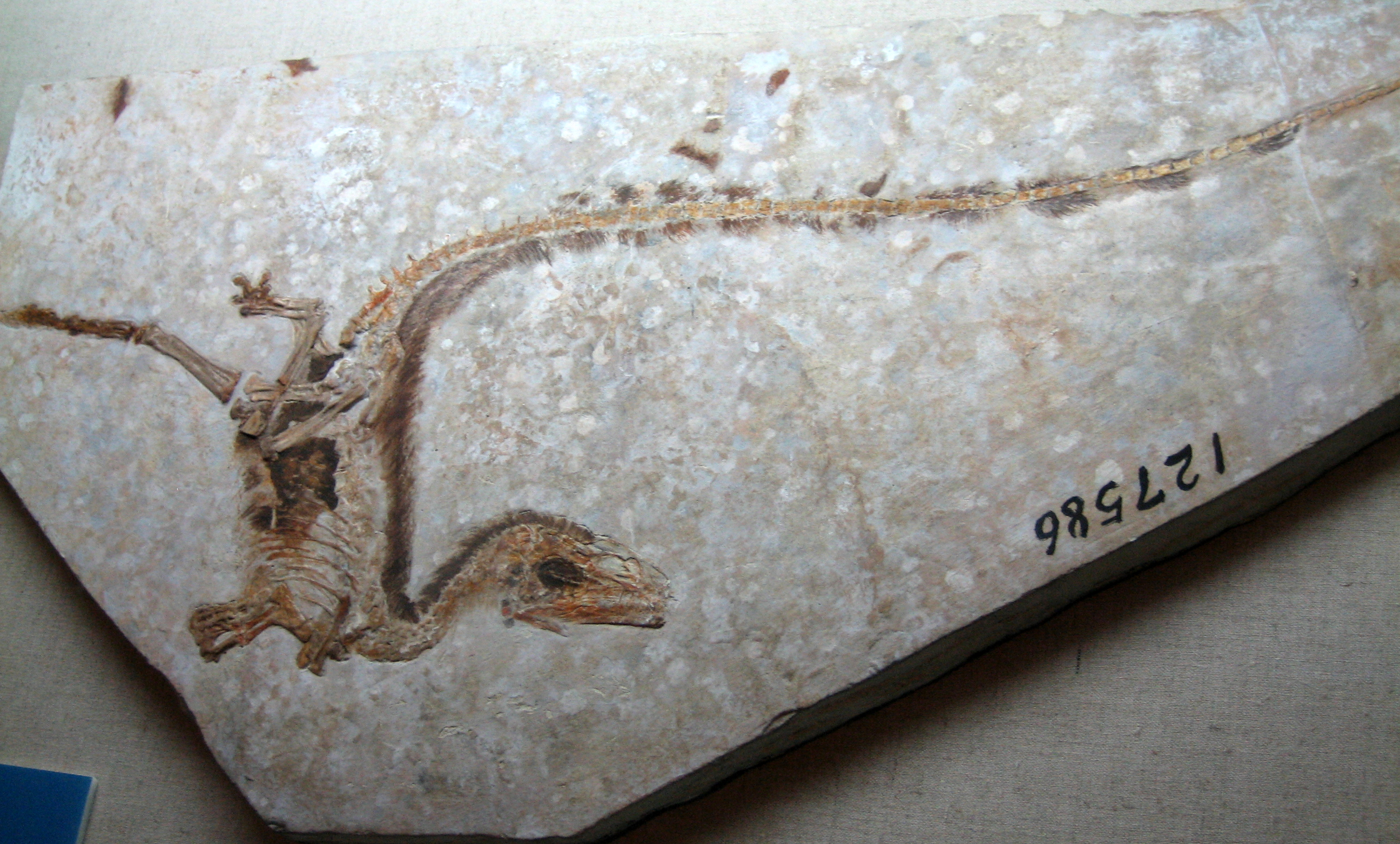
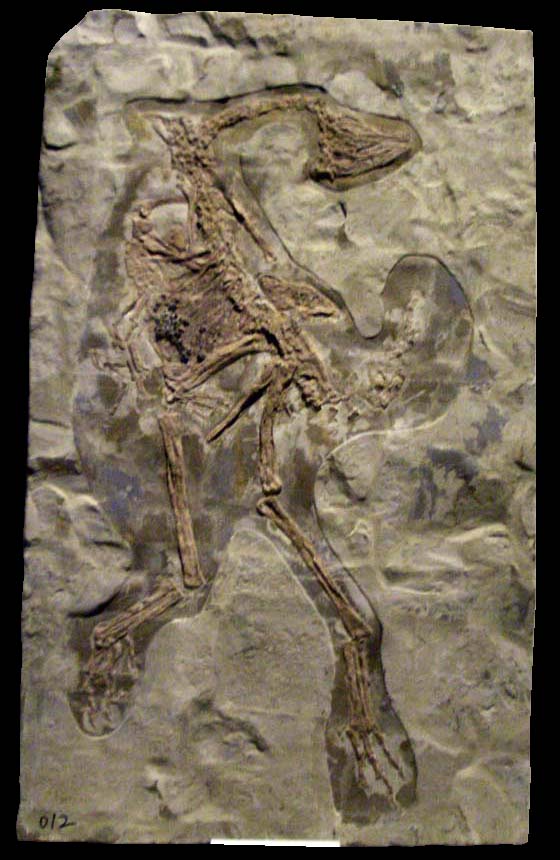
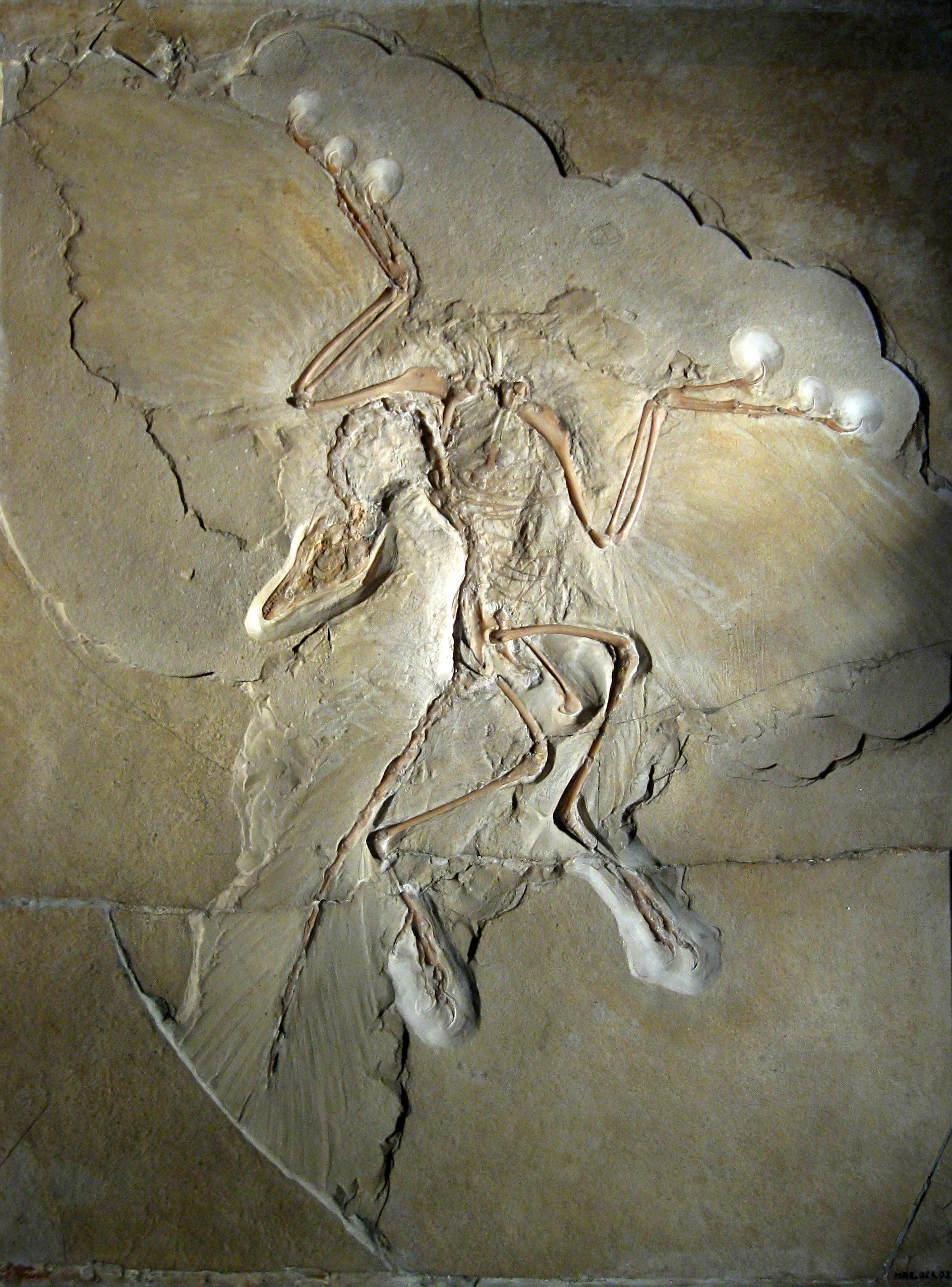
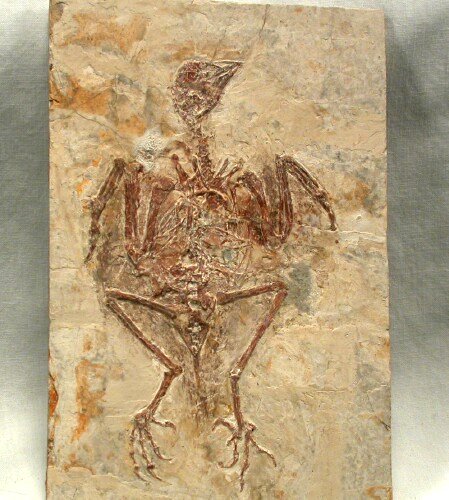
Let's take a jaunt...Lionz wrote:Where's fossil evidence for that if so?
http://en.wikipedia.org/wiki/Sinosauropteryx
http://en.wikipedia.org/wiki/Caudipteryx
http://en.wikipedia.org/wiki/Microraptor
http://oficina.cienciaviva.pt/~pw011/ja ... aoning.htm
http://en.wikipedia.org/wiki/Archaeopteryx
http://en.wikipedia.org/wiki/Jixiangornis
http://en.wikipedia.org/wiki/Sapeornis
http://www.fossilmuseum.net/Fossil-Pict ... nsis-b.htm
http://en.wikipedia.org/wiki/Ichthyornis
http://en.wikipedia.org/wiki/Bird
http://www.ncbi.nlm.nih.gov/pubmed/1184 ... t=Abstract
http://www.ncbi.nlm.nih.gov/pubmed/1113 ... t=Abstract
http://www.ncbi.nlm.nih.gov/pubmed/1119 ... t=Abstract
http://www.ucmp.berkeley.edu/vertebrate ... /aves.html
Did I say that would happen? There are hypotheses that go that route, but I don't think it's particularly helpful to go that route. Other methods are easier to understand and perhaps more likely.Lionz wrote:What would natural selection do to help replicating systems arise in the first place?
You want a list? Ok.Lionz wrote:How about you give a list of evidence that supports common ancestry of wolves and roses or ants and whales if you can come up with one?
http://en.wikipedia.org/wiki/Bioinformatics
http://en.wikipedia.org/wiki/Sequence_alignment
http://en.wikipedia.org/wiki/Computatio ... logenetics
http://en.wikipedia.org/wiki/List_of_tr ... al_fossils
http://en.wikipedia.org/wiki/Comparative_anatomy
http://en.wikipedia.org/wiki/Vestigiality
http://en.wikipedia.org/wiki/Australia (that's right, the whole continent)
http://en.wikipedia.org/wiki/Island_biogeography
http://en.wikipedia.org/wiki/Adaptive_radiation
http://en.wikipedia.org/wiki/Universal_ ... Biology%29
http://en.wikipedia.org/wiki/Cytochrome_c
http://en.wikipedia.org/wiki/Antibiotic_resistance
http://en.wikipedia.org/wiki/Rhagoletis_pomonella
http://en.wikipedia.org/wiki/Peppered_moth_evolution
Why is that better or more likely than just having a universe that has always existed?Lionz wrote:He has always existed and is part of all that exist perhaps.
That's not quite what I'm arguing. All that is purely natural. How about that?Lionz wrote:Who's arguing that the universe has not always existed if the universe is defined as all that exists?
Is there any reason to believe that is the case?Lionz wrote:I'm not sure if there's a perfect definition for Kingdom, Phylum, Class, Order, Family, Genus, or Species maybe, but if scripture suggests He created certain kinds of creatures with an ability to bring forth after their kinds then is there any reason why we should believe that's not the case?
Naturally? Not quite. The fact that organisms change over time is indicative that they have more than just the ability to bring forth their kind. They can bring forth other kinds as well, and have come forth from other kinds.Lionz wrote:What suggests that's not the case? Can we not get zebras and horses to have offspring naturally?
Er... no. There are hardly any fossils in Precambrian rock (not much to fossilize, and certainly no rabbits). Precambrian rocks are pretty much just the really old rocks that are found under rocks from the Cambrian era. They have also been radiometrically dated.Lionz wrote:What's used to determine whether sedimentary rock is precambrian or not regardless of how many rabbit fossil specimens have been found? Index fossils themselves?
None online that I know of, but the results have all been published. I trust the dendrochronologists to be able to figure out solutions to such simplistic errors. Even if I could find an online resource that lined up 11,000 years of trees, what would you say to that?Lionz wrote:Is there a book or place online where we can personally see dendrochronology samples lined up to apparently show over 5,000 years of time? Who knows how many times seperate disturbances have been lined up in error or how many times missing rings have been inferred if that's common in BCP chronology?
I think it's a valid point. People will often see what they want to see.Lionz wrote:How about you and I let petroglyphs speak for themselves without drawing on them?
http://en.wikipedia.org/wiki/Skull#Temporal_fenestraeLionz wrote:Here's an image showing a replica of a skull from a Stegosaurus stenops perhaps...
Was there not apparently something that protruded backwards from sides? And who knows if there have been tools or armor made from Stegosaurus parts? Who knows what's been covered up? Search this in a search engine maybe... Smithsonian nephilim.
Notice that all things that have temporal fenestrae (those holes in the skull that cause that formation) don't have external ears, and those organisms that don't have temporal fenestrae are the ones that develop external ears. That's just part of the shape of the skull, and, at the angle the head was held, those would have pointed straight back toward the rear of the dinosaur.
As far as coverups go, I'm not convinced. There are so many Christians around that I bet if a single one got a hold of some of the things you're hinting at might be covered up, it would be shouted to the skies. Tangible evidence of Biblical veracity; we would never hear the end of it. Instead, we just get shadowmen hiding everything away.
Giraffes? Most likely it's just someone's imagination gone wild. Ancient humans got bored sometimes too.Lionz wrote:What's shown here if not dinosaurs?
Once the concept of a geological column was realized, it happens all the time.Lionz wrote:When has depth of earth been used to try to determine an age for sedimentary rock?
When (relatively) floods were, and to what extent they covered, as well as other typical sedimentary, metamorphic, and igneous formations.Lionz wrote:If flooding can lay down multiple layers of sediment several meters deep then what can depth of earth tell us?
The Colorado River delta.Lionz wrote:Global flooding could have easily dispersed 1.3 million cubic miles of wet sediment far out into the Pacific perhaps, but what suggests the Colorado River washed 1.3 cubic miles of rock somewhere?
If the world was covered in water, fish and coral would be able to go anywhere (assuming they weren't boiled alive), right?Lionz wrote:A global flood would free sharks and fish and coral to grow on all land? What do you mean by that if you said that?
That's probably the most reasonable thing you've said in this entire thread. Nice work on that one. We're assuming the ocean wouldn't boil everything alive because Noah survived, right? But, sure, if the global flood boils, then, yeah, the sharks probably avoided the hot parts. I imagine we would still expect to find a single layer covered in fossils of humans and dogs and cats and stuff like that which would be deposited by the flood.Lionz wrote:Would massive flooding of hot water somehow convince sharks to swim to a higher elevation? It would actually convince sharks to swim lower to try to find colder temperatures maybe.
That's pretty much the definition of a global flood.Lionz wrote:Who's simply giving an explanation of a shit ton of water doing something?
Are there not geological explanations for all of those?Lionz wrote:Does earth contain geothermal features and geysers with more than half of the former and 80% of the later found in Yellowstone? Is there an underground aquifer spanning 8 states and stretching to just east of Yellowstone? Is there a crater in Arizona that was apparently caused by something with an unnaturally shaped end with four sides? Is Snake River Plain just southwest of Yellowstone and the result of water running down and smoothing out land? Is Great Salt Lake a body of salt water that's trapped between mountains? Are Monument Valley and Rainbow Bridge (not sure if RB is technically part of Monument Valley or not perhaps) and Petrified Forest National Park not all apparently located in areas that were once basins of bodies of water? Areas just east and northeast of the Kiabab Uplift and the Grand Canyon? Is there not a main exit of the Grand Canyon with the Algodones Dunes swept off the side just south of it? And is the Morrison Formation not right smack dab in the middle of it all with fossils galore?
Ever heard of jointing? They also found chunks of a meteorite...Lionz wrote:How about we discuss Barringer Crater and move on from there? Did a randomly shaped meteor cause it? You will find it here perhaps... http://www.flashearth.com/?lat=35.02738 ... =0&src=msa
Indeed, we should not without evidence. But we have no evidence to show that it was all deposited at once, and therefore, all wet.Lionz wrote:If we come across a river running through sedimentary rock, we should not assume it was cut through sedimentary rock or wet sediment maybe.
Probably not all the time. But floods and subsequent wind erosion can account for wideness.Lionz wrote:See a largest canyon here? Do you theorize that there's been a river wide enough to reach across it if so?
The sediment would have been very dry then.Lionz wrote:Grand Lake and Hopi Lake resulted from the flood maybe... they might have actually come together to cut the Grand Canyon years after the flood.
Not really. It was just a hypothetical question.Lionz wrote:Is there a dam preventing the Great Lakes from flooding towards the south?
Napoleon Ier wrote:You people need to grow up to be honest.
Well, you're selecting certain pics of artwork and ignoring others. How many other pictures can you find that don't really resemble anything pre-historic? What's interesting is that you also hadn't mentioned the cultural gap. These artworks are all from very under developed-peoples? How is their "word of mouth" supposed to be better than European or Asian written language and science? It is also common knowledge among Archeologists that old civilizations came up with ideas for mythological beasts from Dinosaur Bones they discovered. Archeological journals from the late 1800s through the 30s are littered with observations of strange and unique bones that were discoverd at dig sites in places of importance.... then (sometimes after including sketches) these bones were usually thrown out as rubbish.Neoteny wrote: What's shown here if not dinosaurs?
Image
Giraffes? Most likely it's just someone's imagination gone wild. Ancient humans got bored sometimes too.
Anyway.... so If I remember right I think that the top layers of the Canyon are made from Limestone and Sandstones, but the lowest layers are made of Granite. This would account for the differing widths you can see in the photo. You can kick apart Sandstone but I dare you to drop-kick a chunk of Granite. So yeah....give any water way 15-20 million years and it will show you all the rock beneath it.Neoteny wrote: Lionz wrote:See a largest canyon here? Do you theorize that there's been a river wide enough to reach across it if so?
Image
Probably not all the time. But floods and subsequent wind erosion can account for wideness.
Awe drat! I totally typed that question but deleted part of my post... I accidentally axed it and forgot I had even written it! Thanks Jones!jonesthecurl wrote:On the question of the dinosaurs:
Are you thinking that these relics are pre-Flood perhaps? and that the dinos died out in the Flood maybe ? (to use your Socratic style of posting)
Where were they found, and are the sites where they were found under the deposits laid down from the Flood?
natty_dread wrote:Do ponies have sex?
(proud member of the Occasionally Wrongly Banned)Army of GOD wrote:the term heterosexual is offensive. I prefer to be called "normal"

Did Birds Evolve from Dinosaurs?
Now, the textbooks are going to tell the kids, "Boys and girls, birds are the descendants of dinosaurs." How many have ever heard of that before? Wasn’t that the whole purpose behind the Jurassic Park movie? Now, just hold on a minute, in case you don’t know, there are a few differences between a dinosaur and a bird. You don’t just put a few feathers on him and say, "Let’s go man come on you can do it!" It’s not quite that easy folks. You see, reptiles have four perfectly good legs, birds have two legs and two wings. So if his front legs are going to change into wings (besides lots of other things having to change, like the muscular system, the nervous system to control this and the brain to control flight) besides all of that, somewhere along the line, his front legs are going to be half-leg half-wing. Which means now he can’t run and he can’t fly. This guy is going to have a problem evolving through that stage don’t you think? As a matter of fact, through all the stages he’s going to have a problem evolving.
Scales and Feathers
They tell the kids though, that birds are covered with feathers, (which is true) and they are going to say, "Boys and girls, bird feathers evolved from the same scales that protected the dinosaurs so well." Hold on a second. Feathers are extremely complex. The only similarity they have between feathers and scales is they are both made from the same protein. It is called Keratin. Your finger nails and your hair are made from the same stuff. That doesn’t prove that they are related. It proves they’ve got a common Designer. Did you know battleships and forks are both made out of the same metal? Iron. That proves that they both evolved from a tin can 27 million years ago. (Jump frog jump!) Man, you’re getting the wrong conclu-sions here folks! Similarity proves a common Designer.
Other Differences
There are real problems with the bird evolution from reptiles. The lungs are totally different. Reptiles have a sac type lung. Birds have a tubular type lung. Very different lung system. Modern birds are found in layers with and lower than the so-called dinosaurs. How can they be the ancestors? How can the dinosaurs change to birds? The birds were already there, even by their thinking, with their faulty geologic scale. Scales and feathers attach to the body differently and they come from different genes on the chromosome. Birds have a four chambered heart. Reptiles have a three chambered heart. Major change there, folks! How is that going to survive? In addition to just the heart changing, you have to get the nerve supply changing. And the DNA code changing so the next generation has this heart change. It doesn’t work.
Reptiles lay a leathery egg. Birds have a hard-shelled egg. There are thousands of differences between reptiles and birds. There is no evidence. And the experts know that.
Even W.E. Swinton from the British Museum of Natural History, the largest fossil collection in the world. He said, "there is no fossil evidence of the stages through which the remarkable change from reptile to bird was achieved." Now, he believes that happened, but he knows that there is no fossil evidence. But the textbooks tell the kids that there is.
Archaeopteryx
They show the picture of Archaeopteryx and say, "Boys and girls, this is Archaeopteryx." (Wow—big word, write that down. It will be on the test!) Archaeopteryx. It means "ancient wing." They are going to say, "Boys and girls, this used to be a dinosaur. This is the missing link." It’s a bird, teacher. It’s twelve inches long. Come on! It’s the size of a pigeon. Only six have been found. Some people think they are all fakes. I don’t know. Even if they are legitimate though it’s just a bird. It’s 100% bird! The size of a crow.
Claws and Teeth
They are going to say, "Well, now, he’s got claws on his wings. Do you see those claws right there? Don’t you see? That proves he used to be a dinosaur." Come on now, teacher. Twelve birds today have claws on their wings. The ostrich, the hoatzin, the touraco, the ibis. I can’t name them all but there are twelve birds that have claws on the wings right now! By the way, going from claws to no claws would be an example of losing something, not gaining something. Is that how evolution works? You lose everything until you have it all? I don’t get it.
Well, they are going to say, "Well, he’s got teeth in his beak! See those teeth right there? That proves he used to be a dinosaur!" Well, now, hold on just a minute, some birds have teeth, most don’t. Some reptiles have teeth some don’t. Some fish have teeth, some don’t. Some of you have teeth. Some don’t. That doesn’t prove you used to be a dinosaur. And again, going from teeth to no teeth is losing, not gaining! That’s the opposite of what we need!
Evolving a Loss?
They told me when I went to school, "Man used to have a tail but he lost it because he didn’t need it." I thought, didn’t need it?! Have you ever thought how handy a tail would be? Have you ever come to the door with two sacks of groceries? That would be nice man. Grab that door, open it right up, and swing it around, walk right in there! Have you ever been driving down the highway and wished you had something to hold that can of Coke or tune that radio knob? It would be tougher to put your britches on, I understand all that. Somebody could figure that out, you know, put another zipper or something. I don’t know, they’d figure it out. But what do you mean lost it because we didn’t need it? That’s propaganda! These experts know that there is no evidence for any changing! They say there is fossil evidence and there isn’t!
13. I posted a quote having to do with the second law of thermodynamics that says all known cases of decreased entropy (or increased organization) in open systems involve a guiding program of some sort and one or more energy conversion mechanisms or that says at least something like that and you referred to natural selection as a guiding mechanism for evolution in response maybe. Was there a guiding program of some sort that helped lead to a replicating system coming into existance from a non-replicating system?Warm-blooded vs. cold-blooded
Seemingly forgotten in all the claims that birds are essentially dinosaurs (or at least that they evolved from dinosaurs) is the fact that dinosaurs are reptiles. There are many differences between birds and reptiles, including the fact that (with precious few exceptions) living reptiles are cold-blooded creatures, while birds and mammals are warm-blooded. Indeed, even compared to most mammals, birds have exceptionally high body temperatures resulting from a high metabolic rate.
The difference between cold- and warm-blooded animals isn’t simply in the relative temperature of the blood but rather in their ability to maintain a constant body core temperature. Thus, warm-blooded animals such as birds and mammals have internal physiological mechanisms to maintain an essentially constant body temperature; they are more properly called “endothermic.” In contrast, reptiles have a varying body temperature influenced by their surrounding environment and are called “ectothermic.” An ectothermic animal can adjust its body temperature behaviorally (e.g., moving between shade and sun), even achieving higher body temperature than a so-called warm-blooded animal, but this is done by outside factors.
In an effort to make the evolution of dinosaurs into birds seem more plausible, some evolutionists have argued that dinosaurs were also endothermic,1 but there is no clear evidence for this.2
One of the lines of evidence for endothermic dinosaurs is based on the microscopic structure of dinosaur bones. Fossil dinosaur bones have been found containing special microscopic structures called osteons (or Haversian systems). Osteons are complex concentric layers of bone surrounding blood vessels in areas where the bone is dense. This arrangement is assumed by some to be unique to endothermic animals and thus evidence that dinosaurs are endothermic, but such is not the case. Larger vertebrates (whether reptiles, birds, or mammals) may also have this type of bone. Even tuna fish have osteonal bone in their vertebral arches.
Another argument for endothermy in dinosaurs is based on the eggs and assumed brood behavior of dinosaurs, but this speculation too has been challenged.3 There is in fact no theropod brooding behavior not known to occur in crocodiles and other cold-blooded living reptiles.
Alan Feduccia, an expert on birds and their evolution, has concluded that “there has never been, nor is there now, any evidence that dinosaurs were endothermic.”4 Feduccia says that despite the lack of evidence “many authors have tried to make specimens conform to the hot-blooded theropod dogma.”
Should there not be literally billions of fossils of creatures in a transition between fish and land dwelling tetrapods if universal common descent is true? Is there any reason to assume that Panderichthys or Tiktaalik were anything other than aquatic and what has actually been found of Tulerpeton? Skull fragments, small belly scutes, an incomplete pectoral girdle, an incomplete forelimb and an incomplete hindlimb? It's simply a variety of alligator or crocodile maybe. And were remains of it not recovered from the Tula Region of Russia? It's ironically evidence for a preflood earth with above freezing temperatures across the planet perhaps.NG leads readers to believe that Darwin thought the fossil record supported his theory. But actually he admitted more than once in his famous book6 that the fossil record is an embarrassment to his theory of descent from a common ancestor. He knew that if his theory was true, there should be countless numbers of transitional forms (e.g., 100% reptile, 75% reptile-25% bird, 50% reptile-50%bird, 25% reptile-75%bird, 100% bird and many transitional forms between each of those). Darwin attributed the lack of evidence to our ignorance of the fossil record. But today our museums are loaded with fossils and the missing links are still missing.
As the late Harvard evolutionary geologist, Stephen Gould, put it:
The extreme rarity of transitional forms in the fossil record persists as the trade secret of paleontology. The evolutionary trees that adorn our textbooks have data only at the tips and nodes of their branches; the rest is inference, however reasonable, not the evidence of fossils.7
In a 1979 letter responding to the late creationist, Luther Sunderland, Colin Patterson, then Senior Palaeontologist at the British Museum of Natural History in London, concurred:
I fully agree with your comments on the lack of direct illustration of evolutionary transitions in my book. If I knew of any, fossil or living, I would certainly have included them. You suggest that an artist should be used to visualize such transformations, but where would he get the information from? I could not, honestly, provide it, and if I were to leave it to artistic license, would that not mislead the reader? ... You say that I should at least “show a photo of the fossil from which each type of organism was derived.” I will lay it on the line — there is not one such fossil for which one could make a watertight argument.8
Richard Dawkins’ evolutionist disciple at Oxford University, Mark Ridley, is emphatic:
However, the gradual change of fossil species has never been part of the evidence for evolution. In the chapters on the fossil record in the Origin of Species Darwin showed that the record was useless for testing between evolution and special creation because it has great gaps in it. The same argument still applies. ... In any case, no real evolutionist, whether gradualist or punctuationist, uses the fossil record as evidence in favor of the theory of evolution as opposed to special creation.9 [emphasis in the original]


Does your arbitrarily drawing lines on a pyramid count as evidence for creationism?Lionz wrote:I horizontally flipped this and added lines myself perhaps...
2009 simply happens to be where it is and I didn't start with 2009 and work from there by any means perhaps. Do you want to know where any date comes from?